
Above all things, know thyself!

Thoth-5 of Swords-Defeat
#5. I recognize the manifestation of undeviating justice in all the circumstances of my life.
✦ The Thoth Five of Swords — Defeat: Geburah in Yetzirah ✦
Sephirothic Attribution: Geburah — Severity, Strength, Correction
World: Yetzirah — Formation, the Astral-Mental World
Astrological Attribution: Venus in Aquarius, 1°–10° Aquarius
Element: Air
Golden Dawn Title: Lord of Defeat
The Thoth Five of Swords—Defeat is not merely a card about losing an argument, being humiliated at work, or discovering that somebody else brought a bigger intellectual sword to the meeting.
Its deeper lesson concerns the defeat of authentic Will by fragmented thought.
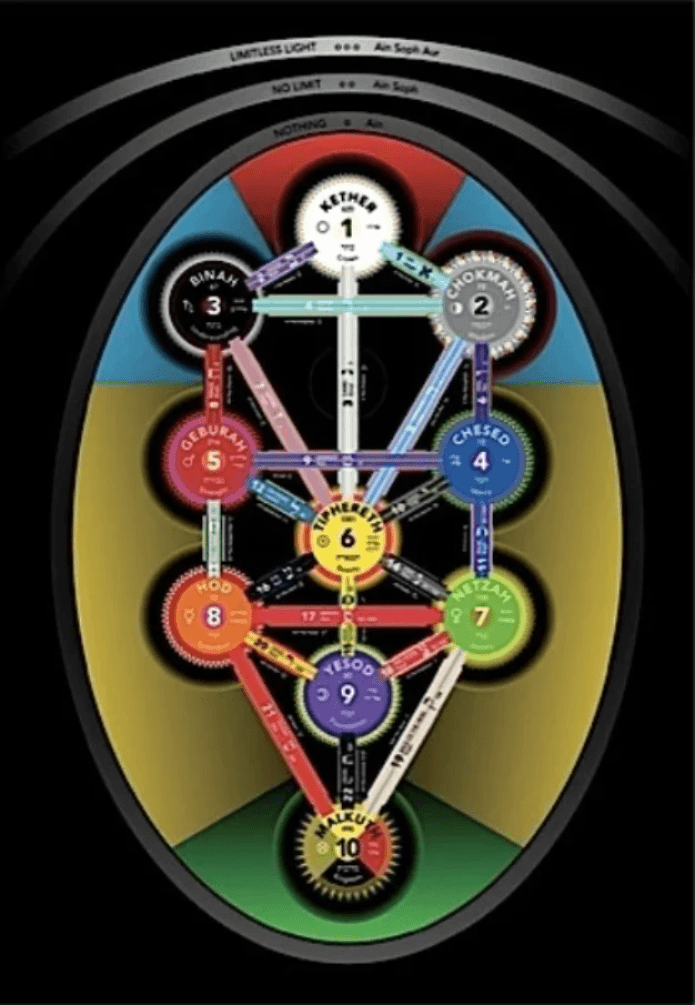
Geburah, the Fifth Sephirah of the Tree of Life, represents severity, strength, discrimination, and corrective force. Its function is not cruelty for cruelty's sake. Geburah cuts away what has become useless, diseased, artificial, or contrary to the essential pattern of the Self.
Spiritually understood, Geburah asks a terrifyingly simple question:
What remains when everything you merely pretend to be is cut away?
That is why the Five of Swords can be uncomfortable. We all wear psychological masks constructed from names, social expectations, family conditioning, advertising, religion, politics, cultural assumptions, praise, shame, fear, and thousands of words absorbed before we possessed enough discrimination to question them.

Eventually we can mistake the description for the Being.
Then we look into the mirror of the unconscious and cannot recognize the face looking back.
The problem is not that we possess words. Words are extraordinarily useful symbols. The problem begins when words possess us.
The mind says:
I am not attractive enough.
I am too old.
I am too young.
People like me cannot do that.
Good people must behave this way.
Successful people must look that way.
Everyone will judge me.
I will fail.
And presently the human being who came into incarnation to experience life is sitting quietly in a corner while an internal committee of inherited opinions holds another emergency meeting.
Geburah enters carrying a sword.
Meeting adjourned.
✦ Geburah — The Severity That Restores the Original Pattern
In Western Hermetic Qabalah, severity is not necessarily punishment. It is discernment through subtraction.
The sculptor does not create the statue by adding more marble. The figure appears because unnecessary stone is removed.

Likewise, Geburah cuts away false identifications so that the underlying pattern can become visible.
The Hermetic Great Work uses similar imagery. Nigredo breaks down false structures; Albedo separates the subtle from the gross; Citrinitas awakens the Solar intelligence; and Rubedo completes the union of Spirit and embodied existence.
Your broader alchemical treatment identifies the Five of Swords particularly with the collapse of mental fortresses and false narratives—the defeat that can become the beginning of genuine transformation.
Therefore, Defeat is not always the defeat of the True Self.
Sometimes it is the defeat of what was preventing the True Self from appearing.
The personality says, “Everything is falling apart!”
The alchemist replies, “Excellent. Let us see what refuses to fall apart.”
That is Geburah.

✦ Geburah in Yetzirah — War in the Formative Mind
The Five of Swords is Geburah in Yetzirah, the World of Formation.
Here the Martial severity of Geburah enters the realm of images, thoughts, emotional patterns, imagination, memory, beliefs, expectations, and psychic formations.
Therefore, the battlefield is primarily internal.
The swords are ideas.
The wounds are divisions in consciousness.
The enemy may be an assumption.
The fortress may be a belief.
And the tyrant may be an internalized voice that has not had an original thought since 1987.
This is why the Five of Swords so often appears when a person is trapped within repetitive mental conflict. Fear causes yesterday's thoughts to colonize today's experience.
Instead of responding to what is happening now, we react to what happened before.
We become yesterday wearing today's clothing.
That is psychological Defeat.

✦ Venus in Aquarius — Love Becomes an Idea
Crowley's description of this card is particularly revealing. He says that Geburah certainly produces disruption here, yet the catastrophe comes from weakness rather than excessive strength. He associates the condition with sentiment weakening intellect and also allows for treachery.
The traditional Golden Dawn attribution is Venus in Aquarius, 1°–10° Aquarius—the first decan of Aquarius.
This creates an interesting tension.
Venus seeks attraction, pleasure, beauty, relationship, harmony, affection, and union.
Aquarius, as Fixed Air, concerns systems, ideas, principles, collectives, social structures, intellectual ideals, and independence.
Venus therefore enters a highly conceptual atmosphere.
Love may become theoretical.
Relationship may become ideological.
Human beings may become categories.
Instead of asking, “What do I actually feel?” the mind asks, “What am I supposed to feel according to the system I have accepted?”
And there is the trap.
Aquarius can envision beautiful futures, humanitarian ideals, unconventional relationships, intellectual companionship, and freedom from obsolete conventions. But its shadow can detach the principle from the living person.
One may love humanity while finding actual humans terribly inconvenient.
That is quite an accomplishment, but not necessarily enlightenment.
Venus in Aquarius therefore asks whether our ideals actually serve life—or whether life is being sacrificed to our ideals.

✦ The Inverted Pentagram — When the Elements Rule Spirit
One of the most striking features of Lady Frieda Harris's Five of Swords is the arrangement of the sword hilts into an inverted pentagram.
Crowley specifically calls attention to this configuration and to the fact that the swords themselves appear crooked, broken, and disunited.
In the Hermetic reading of the pentagram, the upright pentagram may symbolize Spirit governing and harmonizing the four Elements.
Turned downward, the symbolism can suggest the opposite condition:
the elemental personality overwhelming conscious spiritual direction.
Body fear overrules Will.
Emotion overwhelms discrimination.
Habit defeats intention.
Social programming defeats self-knowledge.
The survival intelligence says, “Do not change—you might die.”
The Solar consciousness replies, “If we never change, we are not exactly living either.”
And thus begins the argument.

✦ The Broken Blue Rose — Wisdom Shattered into Opinions
The imagery becomes even more revealing when we compare the Five with the preceding Four of Swords—Truce.
In the Four, the rose has been restored to the center.
In the Five, it is destroyed.
Crowley's description emphasizes that the rose of the previous card has become completely disintegrated. This is an extraordinary symbol of mental fragmentation.
The Rose represents harmony, beauty, integration, and awakened consciousness. Yet the five sword hilts are not uniform. They seem to belong to different mental agendas.
Therefore, we might read them psychologically as competing fragments of thought assaulting a previously unified center.
One voice says:
Be yourself.
Another says:
People will not approve.
Another whispers:
You are not good enough.
Another insists:
Fight everybody.
And the fifth is apparently producing a seventeen-page document explaining why nothing can possibly work.
The Rose does not survive.
Wisdom has been scattered into opinions.

✦ Defeat and the Social Egregore
From a parapsychological and metaphysical perspective, the card can also be interpreted through the concept of the egregore—a collective psychic structure reinforced through repeated attention, symbolism, emotional investment, and group participation.
Families have egregores.
Religions have egregores.
Corporations have them.
Nations have them.
Political movements have them.
Online communities certainly have them—and some appear to survive almost entirely by feeding on indignation before breakfast.
The danger occurs when collective identity replaces individual self-knowledge.
Then the person does not ask:
“What do I know through experience?”
Instead, they ask:
“What is someone belonging to my group supposed to think?”
At that moment, information has replaced Knowledge.
And this distinction is essential to your Hermetic philosophy: information becomes Knowledge only through experience and embodiment; even failure becomes knowledge when consciously assimilated.
Thus, Geburah destroys false certainty so that actual knowing can begin.

✦ The Body Is Not the Enemy
The Five of Swords also reveals another profound form of defeat: war against embodiment itself.
Religious and cultural systems have sometimes taught human beings to regard certain bodily functions, nakedness, pleasure, sexuality, desire, aging, and physicality through lenses of shame or moral suspicion.
From the Hermetic perspective developed here, however, incarnation is not an unfortunate imprisonment of Spirit.
It is an opportunity for Spirit to know itself through sensation.
Without embodiment there is no taste.
No touch.
No fragrance.
No warmth.
No embrace.
No heartbeat felt against another heartbeat.
Spirit may symbolize pure potential, but incarnation gives that potential experience.
This is what I call enfleshenment.

In the language of alchemy, this corresponds beautifully with Rubedo and Coagulation: Spirit is not trying merely to flee matter but to consciously unite with it. Your alchemical treatment describes Rubedo as the Hermetic marriage of Spirit and flesh—the Great Work becoming embodied rather than remaining an abstraction.
Thus, the body is not the enemy of illumination.
The body is one of illumination's instruments.

✦ Celestial Light and Bio-Protonic Flesh
Metaphysically—not as a literal statement of particle physics—we may poetically describe ourselves as Celestial Beings of Light seeking enfleshenment.
Here Light means consciousness, intelligence, Spirit, and formative information.
Matter supplies resistance, sensation, limitation, contrast, and experience.
Joy becomes knowable because sorrow is possible.
Pleasure becomes recognizable because pain exists.
Companionship means something because loneliness exists.
Love becomes intimacy because apparent separation first exists.
Thus, incarnation provides the polarity through which consciousness becomes experientially aware of itself.
The ancient Hermetic formula becomes intensely practical:
As Above, so Below.
As Within, so Without.
As Soul, so Cosmos.

✦ Sexuality as the Mystery of 0 = 2 = 1
This principle also illuminates sexuality.
Rather than treating sexual union merely as something profane or shameful, Hermetic symbolism can approach it as another expression of cosmic polarity.
The One appears as Two.
The Two enter relationship.
And through communion, something arises that neither pole possesses independently.
0 → 2 → 1
This is the mystery of polarity underlying Chokmah and Binah, Sulfur and Mercury, electric and magnetic symbolism, Shiva and Shakti, Sun and Moon.
Thus, sexual intimacy may be approached symbolically as Wholey Communion: two embodied fields of consciousness entering relationship and exchanging physical, emotional, psychological, and symbolic information.
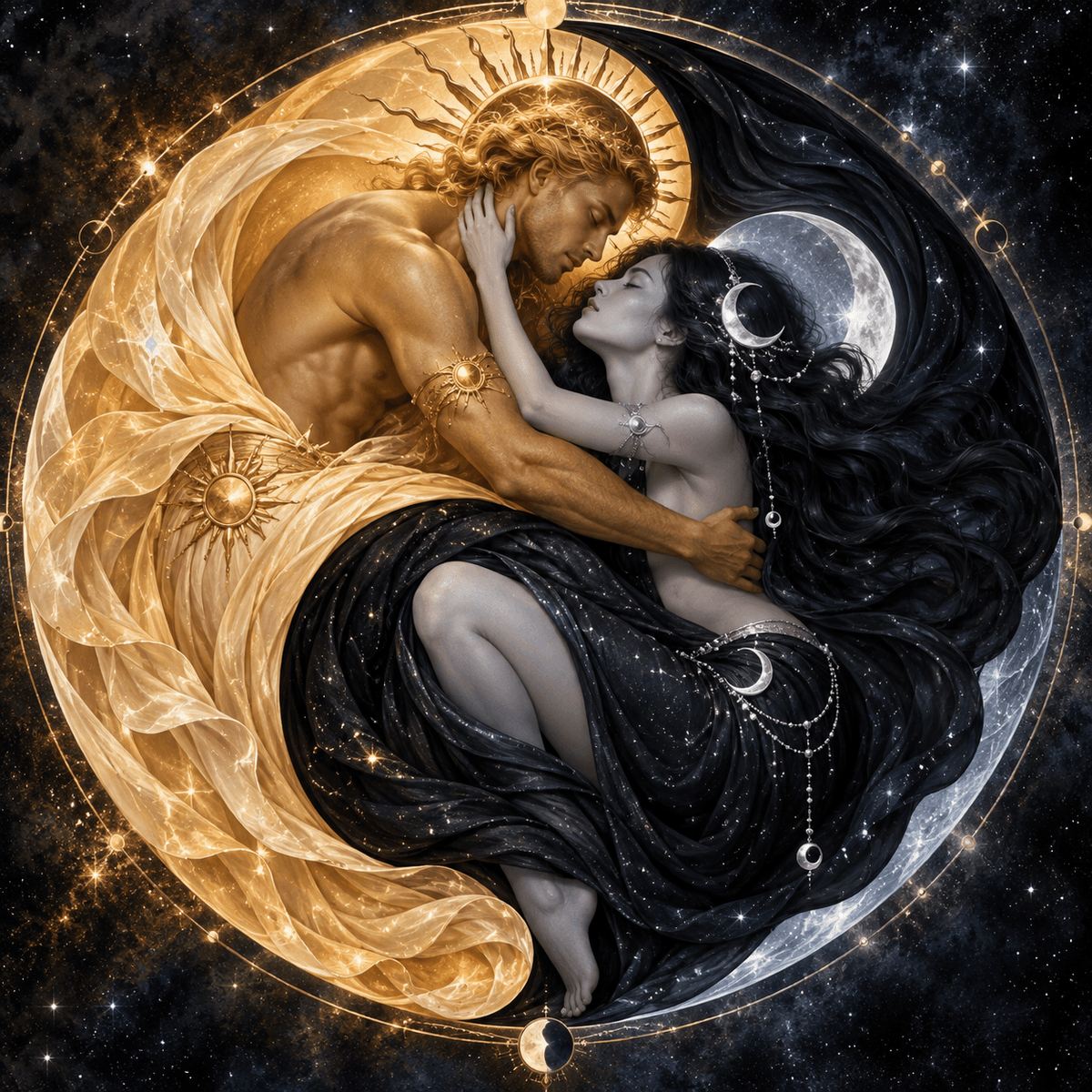
Not every sexual act is sacred simply because it is sexual. Consciousness, consent, affection, responsibility, and intention matter greatly.
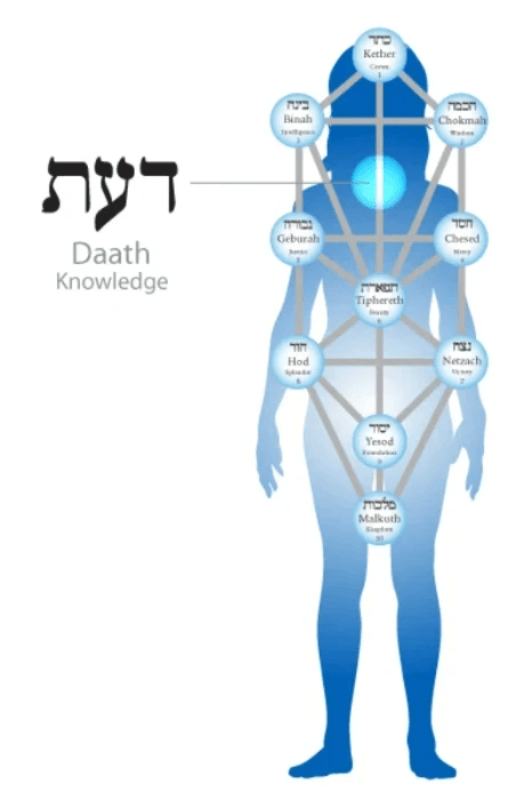
But neither must embodiment be treated as inherently profane.
The Hermetic magician does not defeat the body.
The magician consecrates it.

✦ Mars and Venus — Severity Meets Attraction
Geburah is traditionally associated with Mars, yet this card is astrologically governed by Venus in Aquarius.
Mars divides.
Venus unites.
Mars cuts.
Venus attracts.
Mars asserts.
Venus harmonizes.
Placed together, they create the possibility of either creative tension or destructive conflict.
When properly integrated, differentiation makes relationship possible. Two beings can unite precisely because they remain distinct.
When distorted, Mars becomes aggression while Venus becomes capitulation.
One dominates.
The other abandons itself to preserve harmony.
Neither condition constitutes Love.
Therefore, the Five of Swords warns against a false peace purchased through self-betrayal.
Sometimes surrender is wisdom.
Sometimes surrender is cowardice.
Geburah's task is to know the difference.
✦ The Alchemy of Defeat
The Five of Swords corresponds especially well with Nigredo, the dark stage of alchemical decomposition.
Something must rot.
Something must collapse.
Something must be admitted as unsuccessful.
The ego hates this.
The alchemist understands its necessity.
The Great Work does not promise that every experiment succeeds.
It teaches something much more useful:
Every conscious experiment produces knowledge.
Therefore, defeat becomes dangerous primarily when we convert an event into an identity.
There is an enormous difference between:
“This failed.”
and
“I am a failure.”
The first is information.
The second is enchantment.
Geburah cuts the enchantment.

✦ The Baroque Tarot Five of Swords — The Price of Victory
The Baroque Tarot Five of Swords approaches this mystery through a more recognizable human scene.
An exhausted combatant sits among stones, his clothing disordered, while swords lie scattered near his bare feet. Armored soldiers appear in the rocky landscape behind him, themselves seemingly exhausted by conflict.
Here the emphasis shifts from the internal architecture of the Thoth card toward the aftermath of battle.
The question is no longer simply:
Who won?
It becomes:
What did winning cost?
This is the essence of the Pyrrhic victory.
One may win the argument and lose the relationship.
Win the promotion and lose one's health.
Win ideological purity and lose compassion.
Win control and lose intimacy.
Win every battle and eventually discover there is nobody left with whom to celebrate.
The Thoth card shows the architecture of Defeat.
The Baroque card shows the exhausted human being sitting among its consequences.
Together they deliver a remarkably complete teaching.

✦ When the Five of Swords Appears in a Reading
The querent may be struggling with anxiety, humiliation, mental conflict, pride, ideological rigidity, old fears, self-defeating beliefs, or an overwhelming situation. They may be fighting yesterday's battle in today's circumstances or attempting to preserve an identity that has already outlived its usefulness.
The card can advise the querent to stop wasting force on battles that no longer serve the Will. Pride may need to be swallowed. Limitations may need to be acknowledged. A strategy may need to be abandoned and replaced.
Yet the card does not necessarily mean passive surrender.
Depending upon surrounding cards, it may indicate the necessity of standing one's ground, testing one's strength, persevering against difficult odds, or refusing to capitulate to intimidation.
The critical question is:
Are you fighting because your Will requires it—or because your fear does?
There is no fixed five-week or five-month sentence implied here. Mental conditions can change the instant genuine perception changes.
We are defeated only when we become convinced that no other way exists.
✦ The Greater Teaching of Defeat
The Five of Swords therefore contains a paradox worthy of Geburah:
Sometimes what must be defeated is our idea of ourselves.
The masks fail.
The ideology fails.
The strategy fails.
The relationship to ourselves fails.
The intellectual fortress collapses.
And standing in the rubble is something much older than all of them:
I AM.
The Divine Creative did not make you so that you could spend an incarnation desperately applying for permission to exist.
You already exist.
The Great Work is therefore not the manufacture of a Self.
It is the progressive removal of everything that prevents the Self from being consciously lived.
That is the sword of Geburah.
It does not always feel pleasant.
But surgery rarely sends flowers before arriving.
Above all things, Know Thyself.
And when Defeat arrives, ask:
What exactly has been defeated—the Soul, or merely another false idea about it?
That question transforms the Five of Swords from a card of humiliation into an instrument of the Great Work.
Thank you for your interest, comments, and supportive donations. Your generosity blesses your prosperity. May you live long and prosper.
3 Western Hermetic Tarot and Magick Websites and blogs helping others become more magick and less tragic since 2010
Traditional Tarot Card Comparisons, tarot store and blog.
Western Hermetic Magick ritual and invocation website and magick blog.
Thoth Tarot Card comparisons, tarot store and blog.
