
elitarotstrickingly.com
Above all things, know thyself!
#4. From the exhaustless riches of limitless substance, I draw all things needful both spiritual and material.
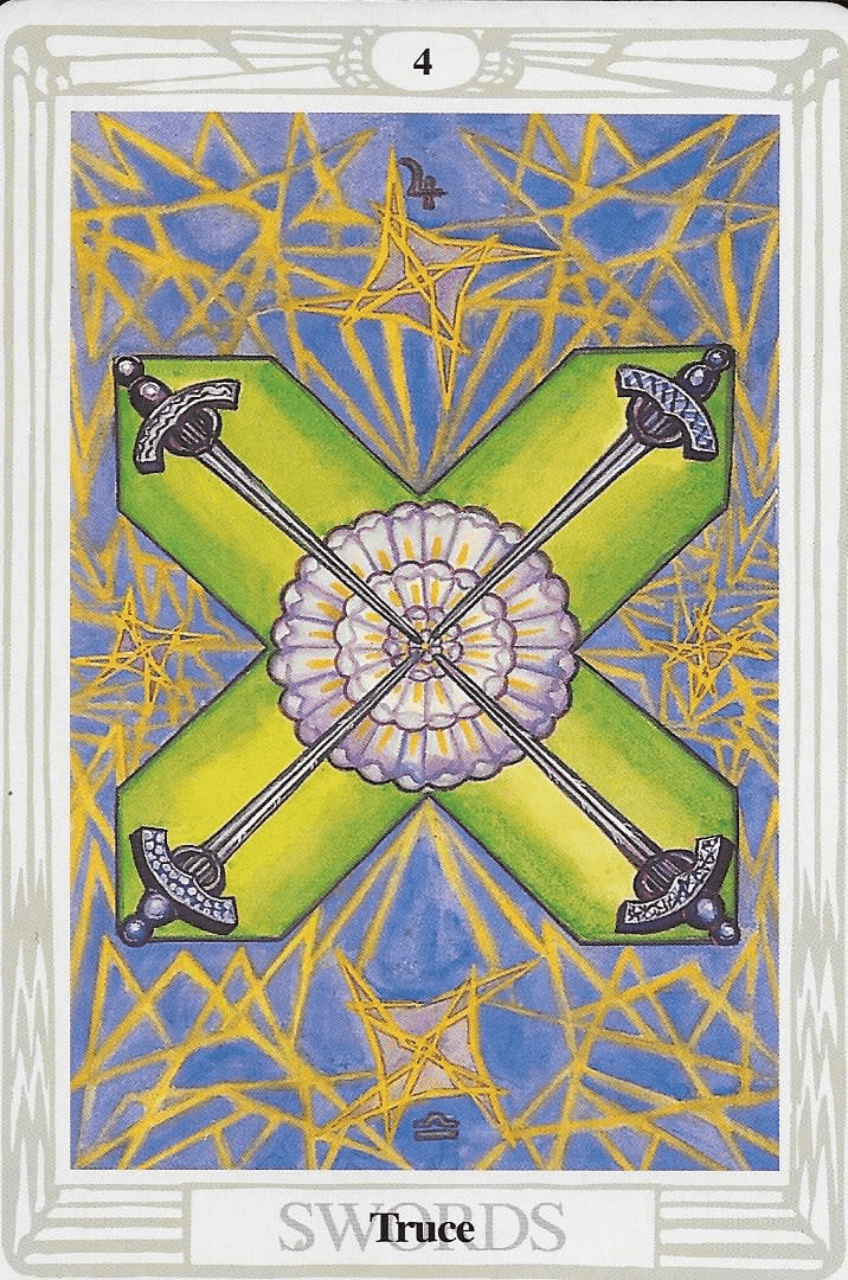
Thoth- 4 of Swords-Truce
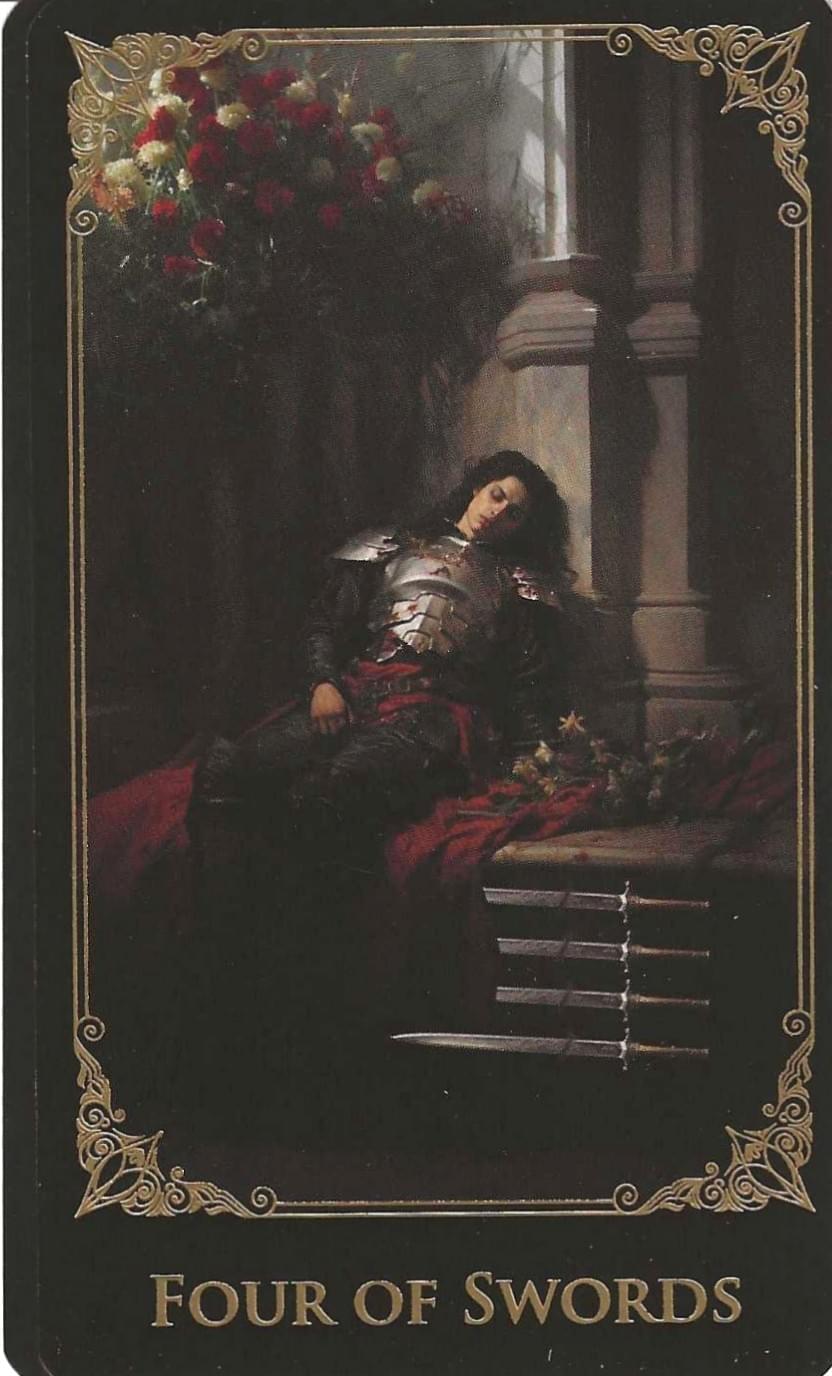
The Baroque Tarot- Four of Swords
✦ Thoth 4 of Swords — Truce & Baroque Four of Swords ✦
Jupiter in Libra, Chesed in Yetzirah, and the Sacred Architecture of Rest
Thoth Title: Truce
Sephirothic Attribution: Chesed — Mercy
World: Yetzirah — Formation
Astrological Attribution: Jupiter in Libra
Suit Element: Air
Hebrew Letter: None directly; the numbered Minor Arcana are governed primarily through Sephirothic, elemental, and astrological correspondences.
The Four of Swords is the silence between arguments, the breath between battles, and the blessed moment when the mind finally realizes that thinking harder is not always the same thing as thinking better.
In the Thoth Tarot, Crowley names this card Truce rather than Peace. That distinction is important.
Peace suggests reconciliation.
A truce merely means everyone has agreed to put down the swords for a while.
Sometimes that is enlightenment.
Sometimes everybody is simply too tired to keep arguing.
Either way, it is progress.

✦ Chesed in Yetzirah — The Architect Builds a Mental Sanctuary ✦
The Four of Swords corresponds to Chesed, the fourth Sephirah of the Qabalistic Tree of Life, operating through Yetzirah, the World of Formation.
Chesed means Mercy, but its function reaches beyond sentimental kindness. Chesed represents order, organization, expansion, law, benevolent authority, and the power that establishes a workable structure.
If Chokmah is explosive force and Binah gives that force limitation and form, Chesed is the great organizer who says:
Excellent. Now let us build something with it.
For this reason, the number 4 repeatedly carries ideas of stability:
- four directions,
- four classical Elements,
- four Qabalistic Worlds,
- four letters of Tetragrammaton,
- four sides of the square,
- and the fourfold foundation upon which manifestation is organized.
Yet this Four occurs in Swords, the Tarot suit of intellect, thought, analysis, language, discrimination, and conflict.
Therefore, Chesed is not constructing a stone temple.
It is constructing a temple of thought.
And because the card operates in Yetzirah, that structure exists within the formative psychic realm—the world of images, emotions, symbols, patterns, and mental formations.
The stability of the Four of Swords is therefore real, but provisional.
It is a mental architecture held together by equilibrium.
Move one sword too quickly and the whole arrangement may begin arguing again.
✦ Jupiter in Libra — The Diplomat Enters the Battlefield ✦
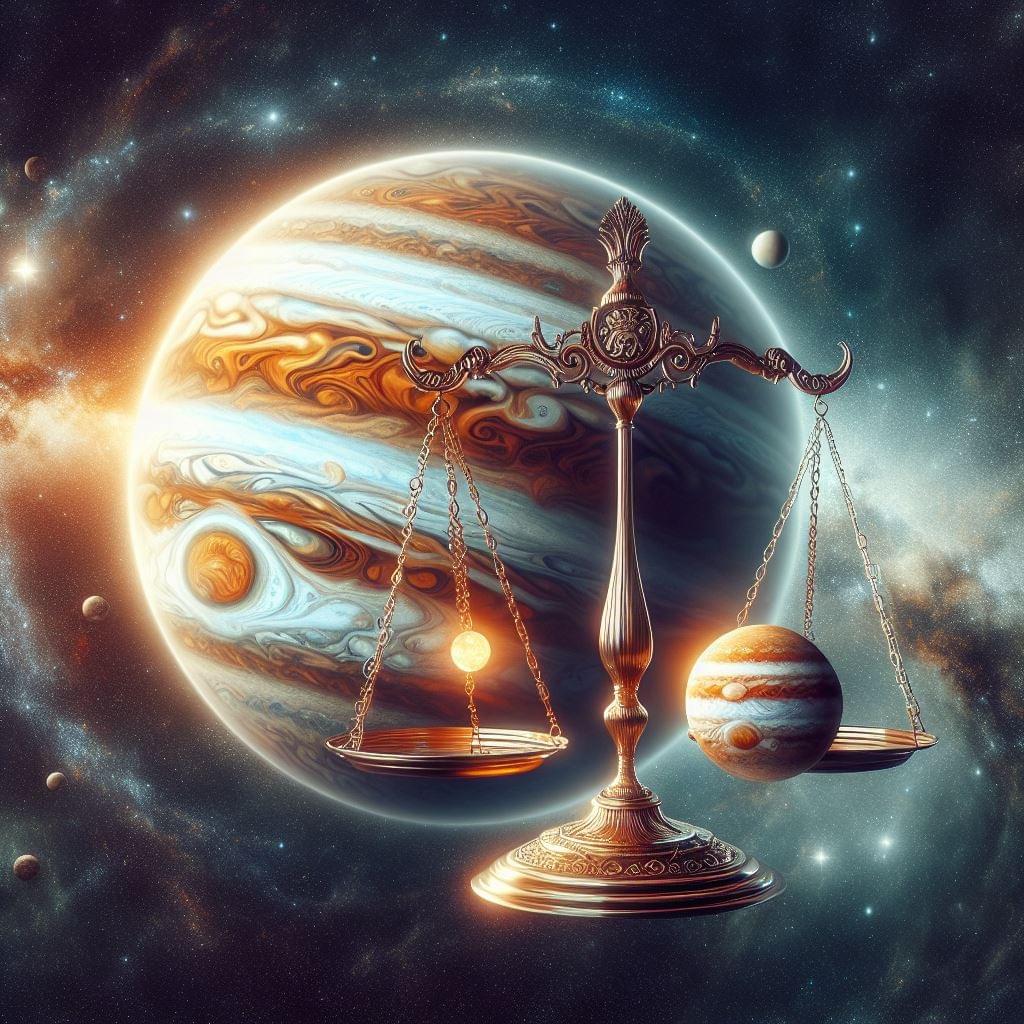
The astrological attribution of the Four of Swords is Jupiter in Libra.
This is beautifully appropriate.
Jupiter represents expansion, law, wisdom, benevolence, social order, philosophy, and the principle of growth.
Libra seeks balance, proportion, justice, relationship, diplomacy, and equilibrium.
Together they create the image of reason attempting to establish civilized order after conflict.
Jupiter says:
“There must be a larger perspective.”
Libra replies:
“And perhaps we could stop shouting long enough to find it.”
This combination favors diplomacy, mediation, reconciliation, ethical reflection, and the willingness to consider more than one point of view.
But there is a shadow.
Libra can become so devoted to balance that decision itself becomes difficult. Jupiter can enlarge whatever it touches—including the number of considerations under discussion.
Therefore, Jupiter in Libra can occasionally produce the fascinating phenomenon known as:
thinking about thinking about thinking.
The Four of Swords says that eventually the scales must be allowed to stop moving.
✦ From Sorrow to Truce — Reassembling the Rose ✦
The transition from the Three of Swords to the Four of Swords is particularly significant.
The Three represents division, contradiction, sorrow, and intellectual separation.
The Four begins to restore order.
What was torn apart is reorganized.
What was emotionally charged becomes capable of contemplation.
What was chaotic begins to acquire structure.
In the Thoth image, the swords form an ordered and symmetrical configuration around the central rose. The image suggests that the intellect has temporarily restrained its tendency to divide everything into opposing positions.
The swords remain swords.
The disagreement has not magically disappeared.
But they have stopped cutting.
That is Truce.
The central rose introduces a Venusian quality of harmony, proportion, and reconciliation into the intellectual world of Air. The image therefore suggests that intelligence cannot ultimately heal itself through analysis alone.
Something softer must enter.
Beauty.
Love.
Relationship.
Mercy.
In Qabalistic language, Chesed restrains conflict through benevolent order.
The intellect is given enough structure to recover its center.
✦ Peace Through Exhaustion ✦
The most important distinction in this card is that Truce is not necessarily resolution.
The opposing forces have stopped fighting, but they have not necessarily become one.
That makes this card psychologically subtle.
Sometimes we stop arguing because wisdom has prevailed.
Sometimes we stop because we are exhausted.
Sometimes the healthiest spiritual practice available is simply:
Enough for today.
There is no shame in that.
A temporary withdrawal can prevent a temporary problem from becoming a permanent catastrophe.
The Four of Swords therefore teaches one of the least glamorous but most useful occult disciplines:
Know when to stop.
Even the Magus must occasionally put down the wand, turn off the phone, drink some water, and cease reorganizing the universe before bedtime.

✦ The Alchemy of Truce — Fixing the Volatile Mind ✦
From an alchemical perspective, Swords correspond naturally with the discriminating and separating faculty.
Alchemy requires separation.
But it also requires recombination.
Solve et coagula—dissolve and coagulate.
The Three of Swords has performed a kind of solve: the previous unity has been divided so its contradictions can become visible.
The Four begins coagula.
The separated components are arranged into a more stable relationship.
Not yet final union.
Not yet the coniunctio.
But enough stability has been achieved for consciousness to observe what has happened.
This is an important part of psychological and spiritual transformation. Constant agitation produces very little wisdom because consciousness requires intervals of stillness in which experience can be assimilated.
The Four of Swords is therefore the athanor of mental recovery.
The fire has not gone out.
It has simply been lowered so that the vessel does not crack.
✦ Metaphysics — The Observer Behind the Thought ✦
The Four of Swords also opens a useful metaphysical question:
Who is observing the mind?
Thoughts arise.
Emotions arise.
Sensations arise.
Memories arise.
Images appear.
And yet something seems capable of witnessing all of them.
Hermetic traditions often use this observation as a doorway into contemplation of the deeper Self.
The ordinary personality says:
“I am angry.”
The contemplative mind learns to say:
“I am aware that anger is present.”
Those are not psychologically identical statements.
The second creates space between consciousness and condition.
That space is the inner Truce.
In Western Hermetic practice, the aspirant may associate this witnessing center with the progressive awakening of the Solar consciousness symbolized by Tiphareth—the harmonizing center of the Ruach and a major station on the journey toward knowledge of the higher Self.
The purpose is not to reject the personality or body.
It is to cease mistaking every passing mental event for the totality of one's Being.
✦ The Body Is Temple, Not Enemy ✦
Some mystical traditions speak of the physical body as illusion, but Western Hermeticism provides a more useful approach:
the body is the vehicle through which consciousness experiences incarnation.
Sight, hearing, touch, taste, smell, emotion, memory, imagination, intuition, and other modes of awareness collectively create our experience of embodied reality.
Esoteric systems have also proposed subtler faculties or “inner senses.” These belong primarily to metaphysical and occult models rather than established physiology, but within ritual practice they represent different modes through which consciousness may interpret subtle experience.
The goal is therefore not to despise the body.
Quite the opposite.
The body is Malkuth—the Kingdom.
It is where the Great Work becomes tangible.
The physical organism may be contemplated as the earthly sanctuary through which the deeper Self participates in Assiah.
The body is not an inconvenient package Spirit accidentally received in the mail.
It is part of the Work.
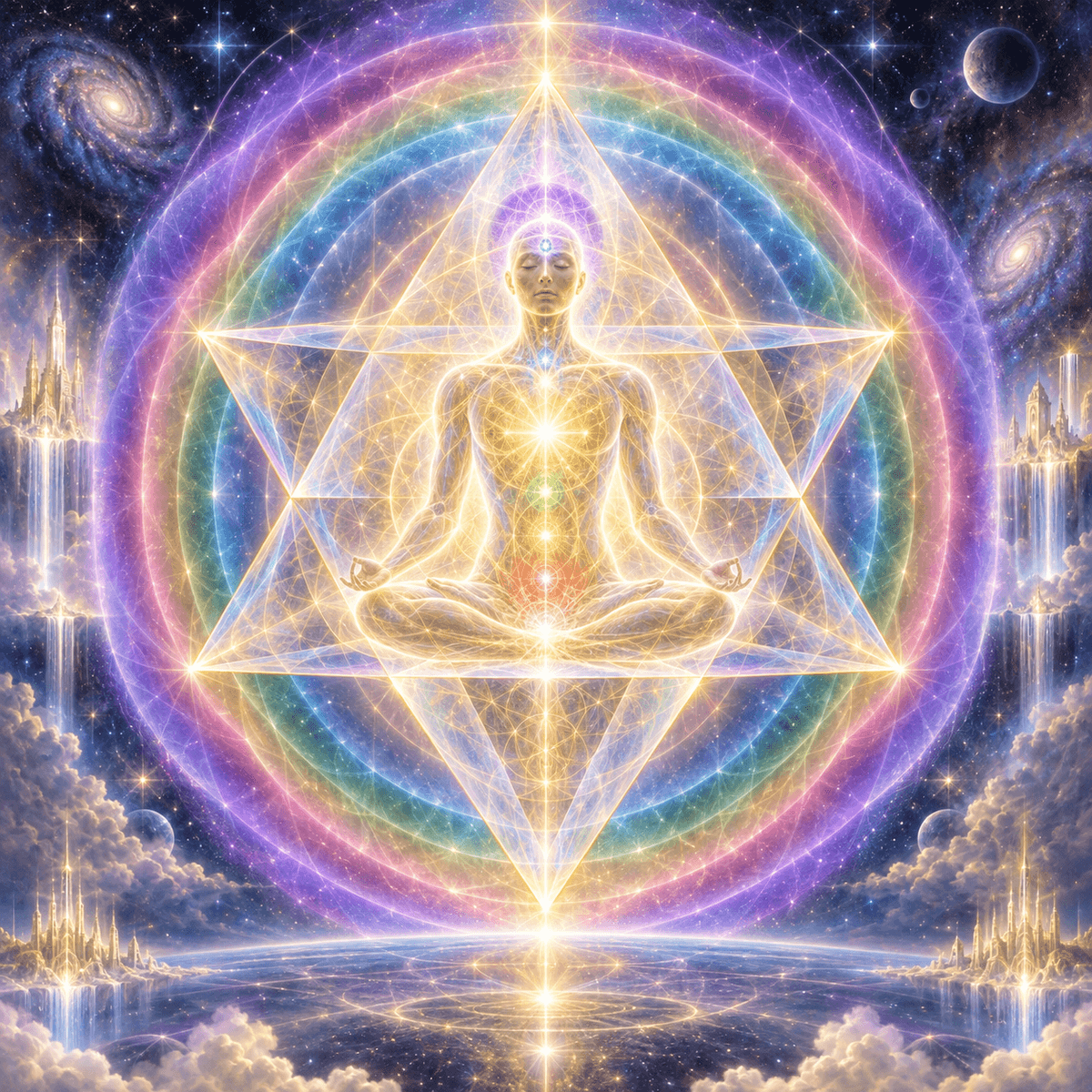
✦ Aura, Merkabah, and the Body of Light ✦
Hermetic and mystical traditions contain many models of subtle embodiment: the aura, astral body, Body of Light, sphere of sensation, and related concepts.
They should not all be treated as identical.
The Hebrew Merkabah literally refers to a chariot, most famously the visionary Divine Chariot associated with Ezekiel. Later mystical and occult systems expanded the idea into models of spiritual ascent and subtle vehicles of consciousness.
For Hermetic meditation, the symbolism is powerful:
Consciousness has a vehicle.
The physical body is one expression of that vehicle.
The psychic imagination is another.
The ritual Body of Light is another symbolic expression.
The Four of Swords asks that vehicle to become still.
When the waters cease moving, reflection becomes possible.

✦ Adam Kadmon — The Archetypal Human ✦
A further Qabalistic key may be found in Adam Kadmon, the Primordial or Archetypal Human.
Adam Kadmon is not simply an enormous invisible person floating somewhere behind the universe.
The symbolism expresses the idea that the human form reflects a cosmic pattern.
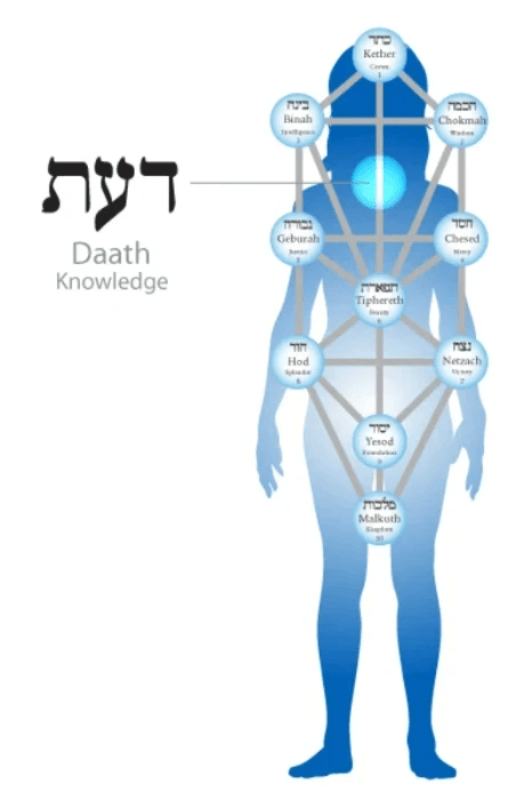
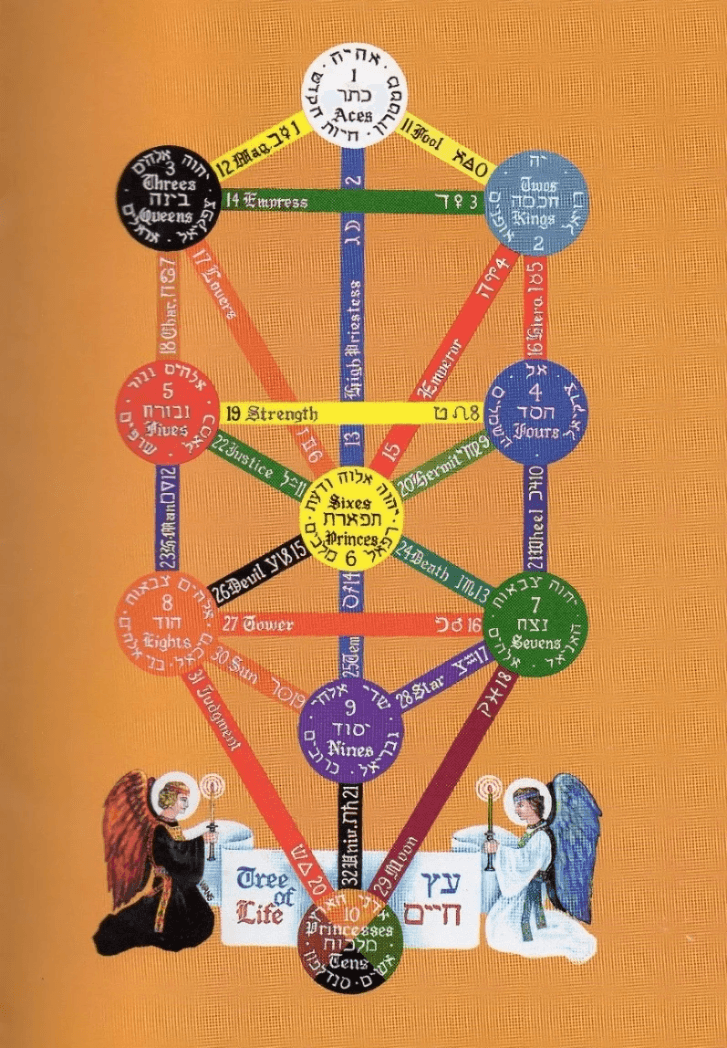
In later Qabalistic and Hermetic contemplation, the Tree of Life may therefore be mapped upon the human figure:
Kether — Crown
Chokmah and Binah — Supernal polarity
Chesed and Geburah — expansive and restrictive powers
Tiphareth — Solar heart
Netzach and Hod — desire and intellect
Yesod — psychic foundation
Malkuth — embodied manifestation
Thus, the human becomes a microcosmic reflection of the Macrocosm.
“As above, so below” becomes more than a slogan printed beneath a mystical Instagram post.
It becomes a discipline of self-observation.
The Tree above and the human below reflect one another.
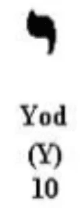
✦ The Yod — The Seed of Creative Will ✦
The Hebrew letter Yod is traditionally described as the smallest letter and the seed from which the other letters emerge.
It also means hand.
Although Yod is not the direct attribution of the Four of Swords, its symbolism beautifully illustrates the Hermetic concept of concentrated creative potential.
A point contains the possibility of extension.
A seed contains the possibility of the tree.
A thought contains the possibility of a world.
The danger, of course, is that not every thought deserves a world.
The Four of Swords therefore teaches discrimination before manifestation.
Before giving energy to a thought-form, allow it to rest.
Examine it.
Ask whether it deserves continued nourishment.
Not every psychic weed requires watering merely because it appeared in the garden.
✦ The Great Truce Within ✦
The deeper meditation of this card is therefore not merely “take a nap,” although on certain days the Tarot is perfectly capable of giving excellent practical advice.
The greater instruction is:
Stop fighting yourself.
For a moment, allow conflicting ideas to exist without forcing an immediate verdict.
Allow consciousness to settle.
Observe.
Listen.
The mental sphere becomes clearer when the Rational Mind stops insisting upon being the only person allowed to speak at the meeting.
Within Hermetic psychology, consciousness may be viewed through several interacting modes: rational cognition, emotional response, subconscious patterning, intuitive perception, and spiritual aspiration.
The Four of Swords temporarily gathers these competing voices beneath the stabilizing authority of Chesed.
The purpose is not suppression.
It is coordination.

✦ Meditation on the Truce Within ✦
Imagine yourself seated within a quiet sanctuary.
The four swords are placed around you.
Not pointing toward you.
Guarding you.
The air becomes still.
Thoughts continue to arise, but you do not pursue them.
Emotions appear, but you do not command them to leave.
You allow everything to become quiet enough to reveal its own nature.
Imagine a deep blue lotus floating upon an immense dark sea.
Above it shines the Solar Light of the deeper Self.
Breathe slowly.
With each inhalation:
I AM.
With each exhalation:
at peace.
Not because every problem has been solved.
Not because every battle has been won.
But because for this moment you have withdrawn your energy from conflict.
This is Truce.
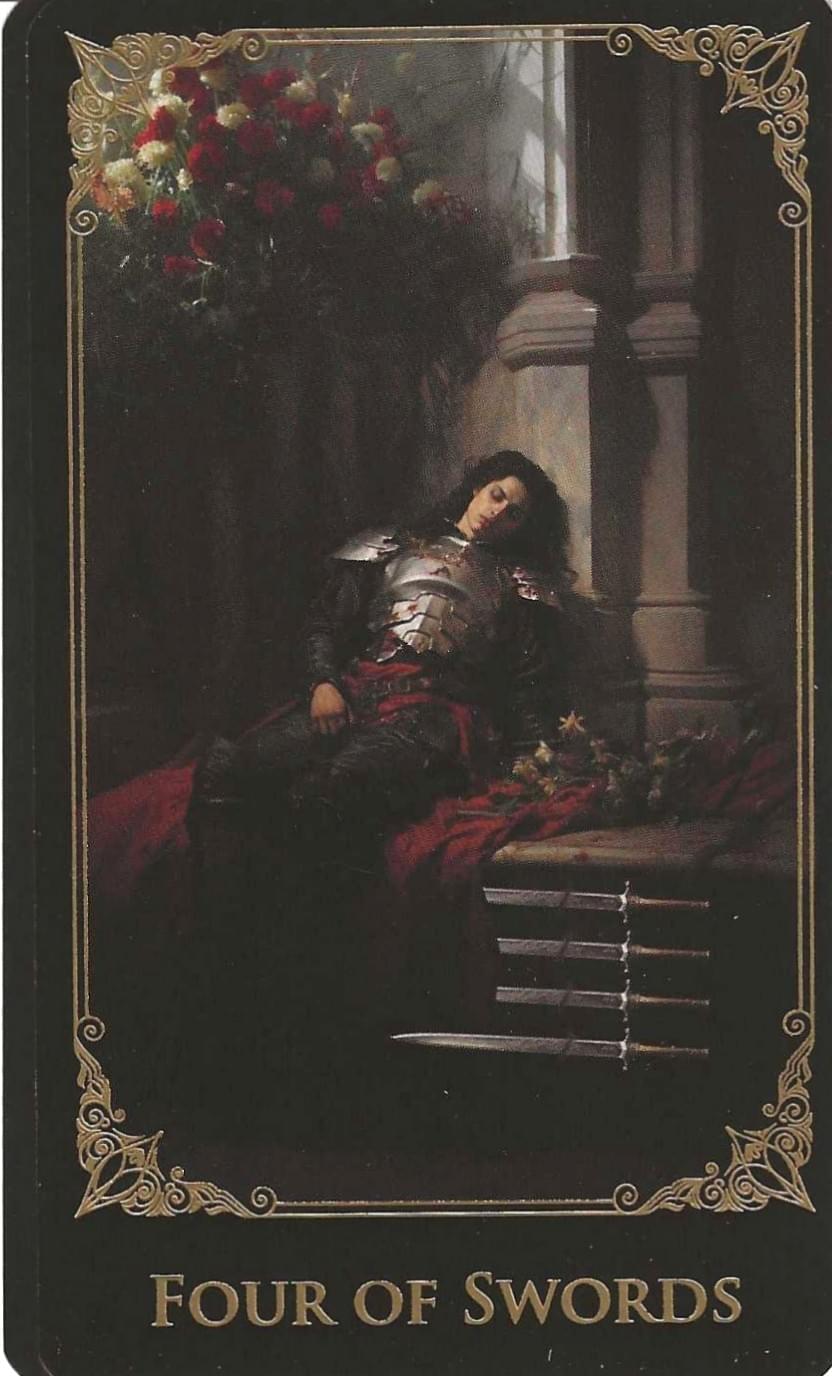
✦ The Baroque Tarot Four of Swords ✦
The Baroque Tarot Four of Swords gives the same archetype a much more dramatic visual expression.
An armored warrior rests against the front of a marble structure beneath a bouquet of white and red roses. Four swords lie upon the steps, partly covered by his red cloak.
Blood upon the armor suggests that battle has already occurred.
The figure may be wounded, exhausted, unconscious, or perhaps even dead.
The ambiguity is appropriate.
Has the warrior chosen to rest?
Or did circumstances make the decision for him?
That question lies at the heart of this card.
The marble building suggests civilization, law, institutional order, government, or established structure—all themes harmonizing beautifully with Jupiter and Chesed.
The warrior appears to have defended that structure until he could go no further.
Now the sword is no longer enough.
The body demands what the intellect refused to provide:
rest.
The message is simple.
If you refuse to schedule recovery, eventually your body may schedule it for you.
And the body is notoriously inconsiderate about checking your calendar first.
✦ Red and White Roses — Passion and Purification ✦
The flowers above the warrior deepen the symbolism.
The red rose may represent passion, blood, desire, vitality, sacrifice, and the active force of life.
The white rose suggests purification, peace, spiritual clarity, and restored equilibrium.
Together they echo an alchemical polarity:
Red and White.
Sulfur and Mercury.
Activity and receptivity.
War and peace.
The warrior beneath them occupies the middle condition.
He is being transformed through stillness.
His battlefield becomes his alchemical chamber.
✦ Parapsychology and the Psychic Field ✦
From a parapsychological or esoteric perspective, prolonged emotional and intellectual conflict can be understood as producing a psychically saturated environment.
Whether interpreted literally as a subtle field or psychologically as the cumulative effect of stress, attention, expectation, memory, and emotion, the practical lesson remains similar:
Repeated conflict conditions consciousness.
Thought feeds thought.
Emotion feeds emotion.
Attention becomes entrained.
The Four of Swords interrupts that feedback loop.
Withdrawal, silence, meditation, sleep, ritual cleansing, nature, contemplative prayer, or simple solitude can reduce the continual reinforcement of the old pattern.
The battlefield becomes quiet enough for another possibility to emerge.
or simple solitude can reduce the continual reinforcement of the old pattern.
The battlefield becomes quiet enough for another possibility to emerge.
✦ Cosmology — Even Creation Has Rhythms ✦
Cosmologically, the Four of Swords represents the principle that manifestation occurs through alternating cycles of activity and rest.
Expansion and contraction.
Day and night.
Inhalation and exhalation.
Creation and dissolution.
Speech and silence.
No universe composed entirely of exhalation would last very long.
The pause is therefore not separate from creation.
The pause is part of creation.
Chesed establishes the boundary within which energy may reorganize itself before the next stage of manifestation.
✦ Theology — Mercy Does Not Always Look Like Victory ✦
The theological lesson of the Four of Swords concerns Mercy.
We often imagine Divine Mercy as rescue, blessing, prosperity, or miraculous intervention.
But sometimes Mercy appears as interruption.
A door closes.
A plan stalls.
The body becomes tired.
The argument ends without resolution.
The road temporarily disappears.
What appears to the personality as stagnation may occasionally function as protection.
Chesed whispers:
Enough. Recover first.
Mercy is not always the force that pushes us forward.
Sometimes Mercy is the hand that prevents us from destroying ourselves through unnecessary momentum.
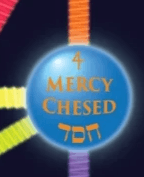
✦ The Number Four — Sacred Structure ✦
The number 4 represents structure throughout much of Western esotericism.
It appears in:
- the four Elements,
- four directions,
- four Qabalistic Worlds,
- four letters of YHVH,
- four suits of Tarot,
- four seasons,
- four corners of the square,
- and the fourfold ordering of manifested existence.
Within the Tree of Life, Four is Chesed, the expansive power of Mercy and organized authority.
The square is particularly relevant.
Three points may create a plane.
Four establish an enclosure.
Thus, Four says:
Here is a space in which something can remain stable.
In the Four of Swords that enclosure becomes psychological.
A protected mental chamber has been constructed.
Enter it.
Close the door.
The universe can manage without your supervision for twenty minutes.
Probably.
✦ When the Four of Swords Appears in a Reading ✦
The card may indicate that a matter has reached a temporary point of mental equilibrium. Something difficult has been understood sufficiently that continued effort will not presently improve it.
Its divinatory possibilities include:
Mental integration.
A situation is being understood on several levels—rational, emotional, subconscious, and spiritual.
Temporary withdrawal.
Step away from conflict so insight can develop without constant interference.
Recovery.
Mental or physical recuperation may be necessary before meaningful progress can continue.
Contemplation.
Silence, meditation, reflection, therapy, prayer, journaling, or solitude may reveal what constant activity concealed.
A holding pattern.
Conditions are temporarily stabilized, but the underlying situation may not yet be resolved.
Strategic retreat.
Withdrawal is not necessarily defeat. Sometimes leaving the battlefield preserves the strength required to eventually transform it.
Discriminating intelligence.
Planning and clear reasoning replace impulsive reaction.
Temporary stagnation.
Events may seem suspended while psychological or practical reorganization takes place.
✦ When Truce Becomes Stagnation ✦
Every Four can become too stable.
Structure can become rigidity.
Protection can become isolation.
Rest can become avoidance.
A truce can become an excuse never to address the original conflict.
In poor dignity or difficult surrounding cards, the Four of Swords can therefore suggest:
- excessive withdrawal,
- avoidance,
- burnout,
- enforced inactivity,
- restlessness,
- isolation,
- prolonged indecision,
- fear of re-entering life,
- or refusing necessary recovery until circumstances force it.
The lesson is not simply:
Rest.
It is:
Rest consciously so that you can return renewed.
There is a considerable difference between retreating into the sanctuary and moving into it permanently.

✦ The Higher Teaching — Peace Is a State of Being ✦
Ultimately, the Four of Swords asks us to recognize that genuine peace cannot be manufactured through endless intellectual effort.
The mind may arrange the conditions.
It may create the chamber.
It may establish the truce.
But eventually it must become quiet.
Then something deeper may become perceptible.
Behind thought is awareness.
Behind personality is Being.
Behind every temporary declaration of “I am this” or “I am that” lies the more mysterious statement:
I AM.
The Four of Swords therefore represents a sacred interval in the Great Work.
The swords remain.
The questions remain.
Life remains gloriously unfinished.
But for one luminous moment the winds become still, the scales balance, and consciousness remembers that it does not have to fight every battle the instant it appears.
Sometimes wisdom is not another answer.
Sometimes wisdom is silence.
And sometimes the most advanced magical operation you can perform is to close your eyes, breathe deeply, and leave the cosmos alone for an afternoon.
Thank you, Dear Reader, for spending a little of your time with me today. Your interest, thoughtful comments, and generous donations are deeply appreciated and help support the continued sharing of these Tarot teachings. May your journey be filled with wisdom, wonder, and a little Magick along the way. May you live long and prosper.
🔥 Thoth Master Class
Western Hermetic Qabalah & Tarot
Private One-on-One Esoteric Training with Magus Eli
This Isn’t a Tarot Class. This Is a Soul Activation.
Step into the current of Living Light.
The Thoth Master Class is a one-on-one initiatory experience that fuses Hermetic wisdom, Qabalistic structure, and the archetypal genius of the Thoth Tarot — all personally guided by Magus Eli, master teacher and Solar Self awakener.
These aren’t generic lectures. They are ritual-grade, soul-specific transmissions designed to unlock your inner Temple, align your psychic architecture to the Tree of Life, and awaken your resonance with the living language of Tarot.
🌞 What Makes This Class a True Initiation?
🎓 Private Apprenticeship: Just you and the Magus in a deep 2-hour Google Meet session, entirely focused on your development.
🔄 Flexible Rhythm: Weekly, biweekly, or monthly — you set the pace. (12 sessions recommended for full arc of mastery.)
📹 Recorded Sessions: Each class is recorded so you can revisit the teachings and track your spiritual evolution.
🌿 Living Hermeticism: You won’t just learn about Qabalah — you’ll live it, feel it, and integrate it into your energetic field.
🃏 Practice Meets Power: You’ll lay spreads, decode symbols, and channel Tarot through your own voice, with real-time feedback and co-interpretation.
🜂 What You'll Learn (and Embody):
The entire architecture of the Thoth Tarot: Major Arcana, Minor Arcana, and Court Cards through a Hermetic lens
The Western Hermetic Qabalah: 10 Sephiroth, 22 Paths, and the Four Qabalistic Worlds
How to use Tarot as a portal to meditative pathworking and astral temple building
Rituals, spreads, and practices that bring gnosis, guidance, and transformation
How to build your personal mystical system, rooted in self-authority and Divine resonance
📚 What You’ll Need to Begin:
The Qabalistic Tarot: A Textbook of Mystical Philosophy by Robert Wang
A Thoth Tarot deck (Crowley-Harris edition preferred)
A Book of Shadows or personal journal
A desire to know thyself through the Solar Flame
🌟 Is This Class for You?
Yes — if you are:
A beginner with a soul-call to the Thoth deck, but no formal training
An experienced reader seeking depth, ritual, and Hermetic context
A mystic ready to reclaim your path through archetype, symbol, and gnosis
Anyone craving one-on-one spiritual mentorship in the Western Esoteric Tradition
✉️ How to Begin Your Journey
Email eli@elitarotstrickingly.com
to schedule your personal resonance mapping session and secure your first class.
🌞 Final Invocation
Awaken the archetypes within.
Speak the language of stars.
Enter the radiant mysteries of the Thoth Tarot.
Begin your Master Class.
Begin your Return.
3 Western Hermetic Tarot and Magick websites helping people become more magick and less tragic since 2010
For information concerning personal, online Thoth Tarot Reading and/or Master Tarot classes, log onto-www.elitarotstrickingly.com- and click on the Tarot/Store page. Thank you.
Traditional Tarot Card Comparisons blog and tarot reading store.
Western Magick Ritual and invocation website and Blog.
