
elitarotstrickingly.com
Above all things know thyself!
[Thoth Tarot Card decks and Book of Thoth purchasable at webstore of elitarotstrickingly.com]
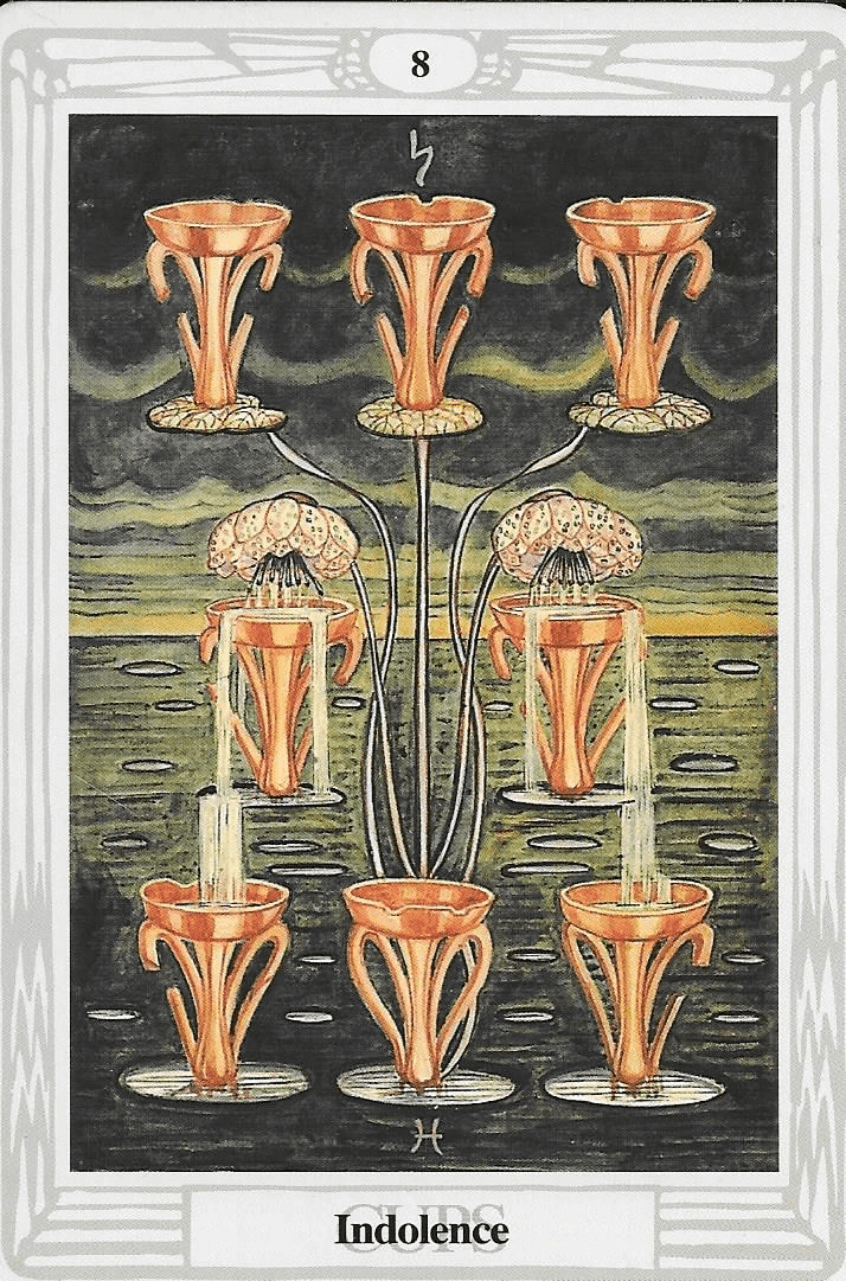
Thoth-8 of Cups-Indolence
Lord of abandoned success.
#8. I look forward with confidence to the perfect realization of the Eternal Splendor of the Limitless Light.
The Eight of Cups: When the Soul Grows Tired of Drinking from Empty Vessels
Saturn in Pisces — The Alchemy of Disillusionment, Spiritual Renewal, and the Courage to Walk Away
There comes a moment in almost everyone's life when the things that once provided emotional satisfaction no longer nourish the Soul.
The career once passionately pursued becomes exhausting. A relationship once filled with excitement becomes an exercise in endurance. An old belief system no longer answers the questions arising from an expanding consciousness.
Even our favorite spiritual practices can become mechanical repetitions, performed out of habit rather than inspiration.
Welcome to the Eight of Cups, where the Soul announces:
"I have experienced enough of this particular lesson. Now, where did I leave my walking shoes?"
In the Western Hermetic Tarot, the Eight of Cups represents a profound transition in consciousness. It describes the exhaustion of old emotional patterns and the necessity of discovering a more authentic expression of the Spiritual Self.
However, the Thoth and Baroque decks approach this teaching from different perspectives.
The Thoth Eight of Cups — Indolence: The spiritual and emotional waters have become stagnant. Inspiration has weakened, and the personality is trapped in patterns that no longer support growth.
The Baroque Eight of Cups: The individual recognizes the exhaustion of an existing situation and gathers the courage to leave familiar circumstances in search of deeper meaning.
One card illustrates the problem.
The other illustrates the journey toward a solution.
Together, they express an essential principle of Western Hermetic philosophy:
Consciousness must remain in motion if it is to continue revealing itself through experience.
1. The Thoth Eight of Cups: Indolence — The Poisoned Waters of Consciousness
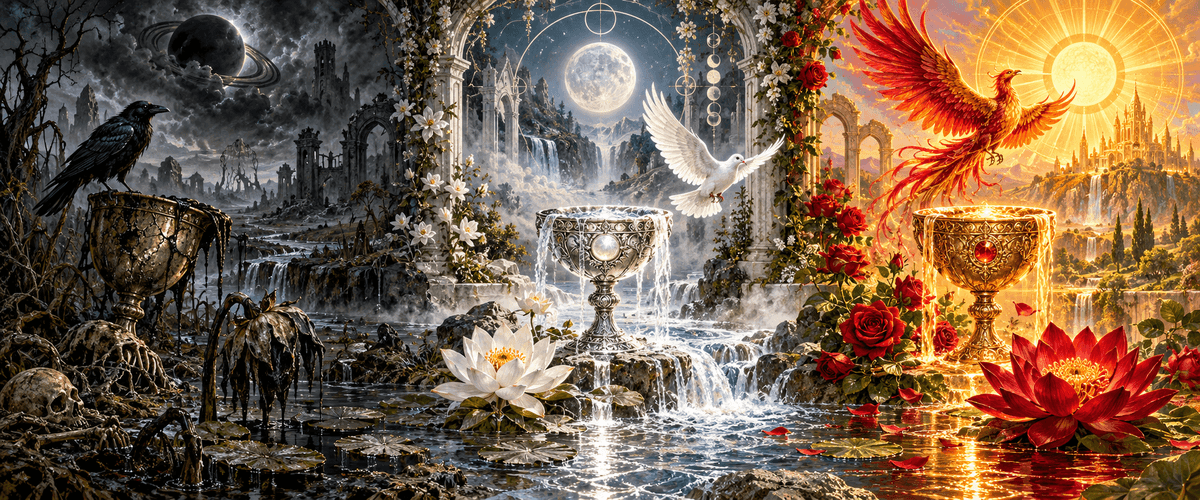
The Thoth Eight of Cups, titled Indolence, presents an atmosphere of spiritual exhaustion.
Eight tarnished and deteriorating cups occupy a desolate landscape. The lotuses that should nourish them droop, their life-giving waters diminished. Above the scene, a weakened Sun struggles to penetrate the oppressive sky.
The ground appears poisoned, incapable of supporting healthy growth.
This is no ordinary garden suffering from a forgotten watering schedule!
It is an image of the emotional and subconscious nature deprived of spiritual nourishment.
The cups represent vessels of experience. Their deteriorating condition suggests that the emotional patterns they contain have outlived their usefulness.
The once-flowing Sea of Mind has become a collection of isolated pools.
Where inspiration once circulated, habitual repetition now dominates.
Where enthusiasm once illuminated the personality, indifference has settled in.
Indolence is the condition in which emotional energy remains present but has lost its meaningful direction.
In Hermetic terminology, the personality continues operating, but its conscious participation in the creative movement of Spirit has diminished.

The individual may continue working, socializing, and fulfilling responsibilities while inwardly experiencing a profound sense of emptiness.
The machinery operates, but the Magus has apparently stepped out for coffee!
Nevertheless, the card does not declare that the Soul has lost its Light.
It suggests that the personality has temporarily lost conscious contact with that Light.
There is an important difference.
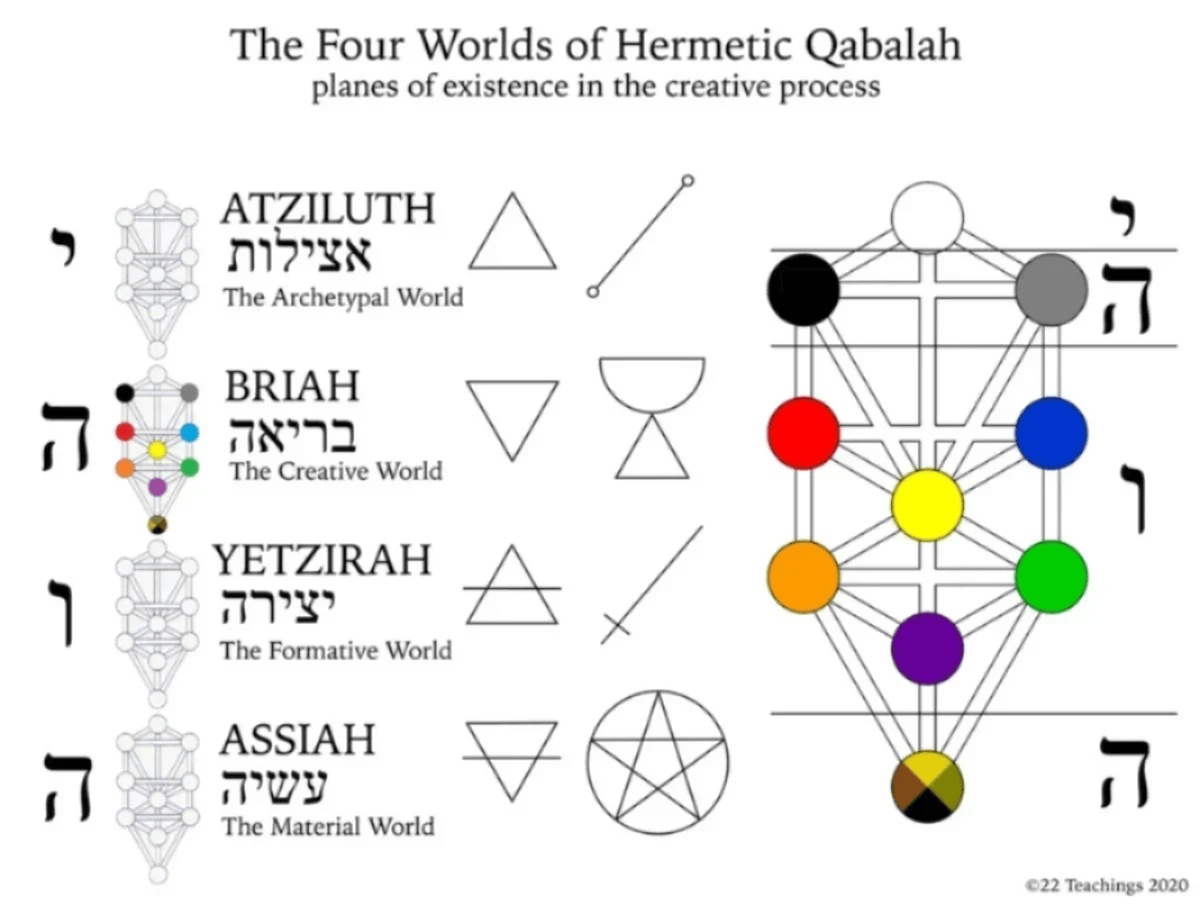
2. Hod in Briah — The Mental Architecture of the Creative World
The Eight of Cups expresses Hod, the Eighth Sephirah, operating in Briah, the Creative World.
Hod means Splendor or Glory. It governs intellectual organization, symbolic interpretation, analysis, language, and the formulation of coherent thought.
On the Tree of Life, Hod balances Netzach, the Seventh Sephirah of Victory, associated with desire, instinct, emotion, and the motivating powers of nature.
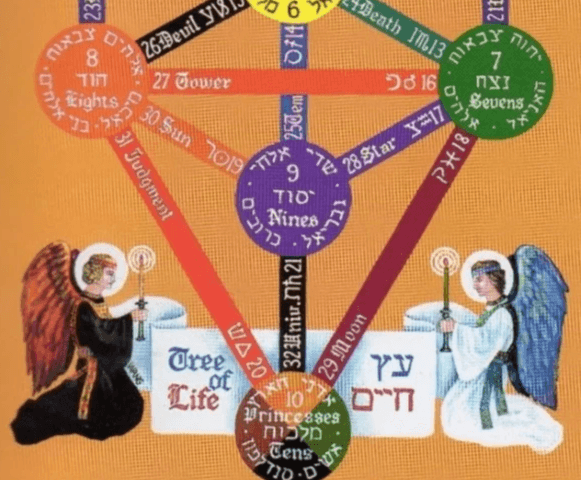
Together, Hod and Netzach represent complementary functions of the developing personality.
Netzach supplies passion and emotional motivation.
Hod provides understanding, classification, and organization.
In ordinary language:
Netzach wants to experience life. Hod wants to understand what just happened!
Both are necessary.
Without emotional motivation, intellect becomes sterile.
Without intellectual organization, emotional energy can become chaotic.
In Briah, the World traditionally associated with the archangelic order and the element Water, Hod symbolizes the organization of subtle creative and emotional patterns.
Here, consciousness begins giving recognizable structure to the symbolic contents of the Soul.
However, when Saturn in Pisces dominates this arrangement, structure can become imprisonment.
The same mental architecture that once helped organize experience becomes a collection of rigid assumptions and repetitive emotional responses.
The personality begins mistaking familiar patterns for absolute reality.
Instead of responding creatively to new experiences, it continually recycles conclusions from the past.
Thus, the Eight of Cups illustrates the intellectual imprisonment of emotional consciousness.
The solution is not abandoning intellect.
It is restoring its relationship with the living creativity of Spirit.

3. Saturn in Pisces — The Crushing Weight upon the Inner Ocean
Astrologically, the Thoth Eight of Cups corresponds to Saturn in Pisces, specifically the first decan of Pisces, approximately 0°–10°.
Saturn represents limitation, responsibility, endurance, structure, discipline, and the consequences of time.
Its traditional alchemical metal is lead.
Pisces, a mutable Water sign ruled traditionally by Jupiter, symbolizes imagination, compassion, receptivity, spiritual longing, and the dissolution of boundaries.
Pisces seeks union.
Saturn establishes separation.
Pisces dreams of infinity.
Saturn asks whether infinity has submitted the proper paperwork!
Within the Eight of Cups, these influences produce a difficult relationship.
The boundless waters of Pisces encounter Saturn's restrictive structures.
The result may be emotional exhaustion, disillusionment, uncertainty, or the feeling that life's possibilities have narrowed.
Yet Saturn is not inherently destructive.
Saturn also teaches discernment, patience, emotional responsibility, and the necessity of boundaries.
This distinction is important.
Without Saturn, Pisces may become lost in fantasy, excessive sacrifice, or emotional confusion.
Without Pisces, Saturn may become rigid, cold, and incapable of compassion.
Their successful integration produces disciplined imagination and compassionate responsibility.
Seven Hermetic Lessons of Saturn in Pisces
Spiritual responsibility: Genuine spiritual development requires dedication rather than endless speculation.
Emotional boundaries: Compassion does not require surrendering personal sovereignty.
Practical idealism: Dreams become meaningful when supported by deliberate action.
Acceptance of limitations: Recognizing present boundaries can reveal the next stage of growth.
Structured creativity: Inspiration becomes productive through patience, practice, and persistence.
Discernment in relationships: Loving others does not require carrying emotional burdens that properly belong to them.
Karmic accountability: Repeated patterns invite examination of the choices and conditions that sustain them.
Saturn in Pisces therefore presents a paradox.
The same influence that appears to restrict emotional freedom can eventually teach the individual how to exercise that freedom responsibly.
Saturn does not necessarily destroy the dream. Sometimes Saturn demands that the dream grow.
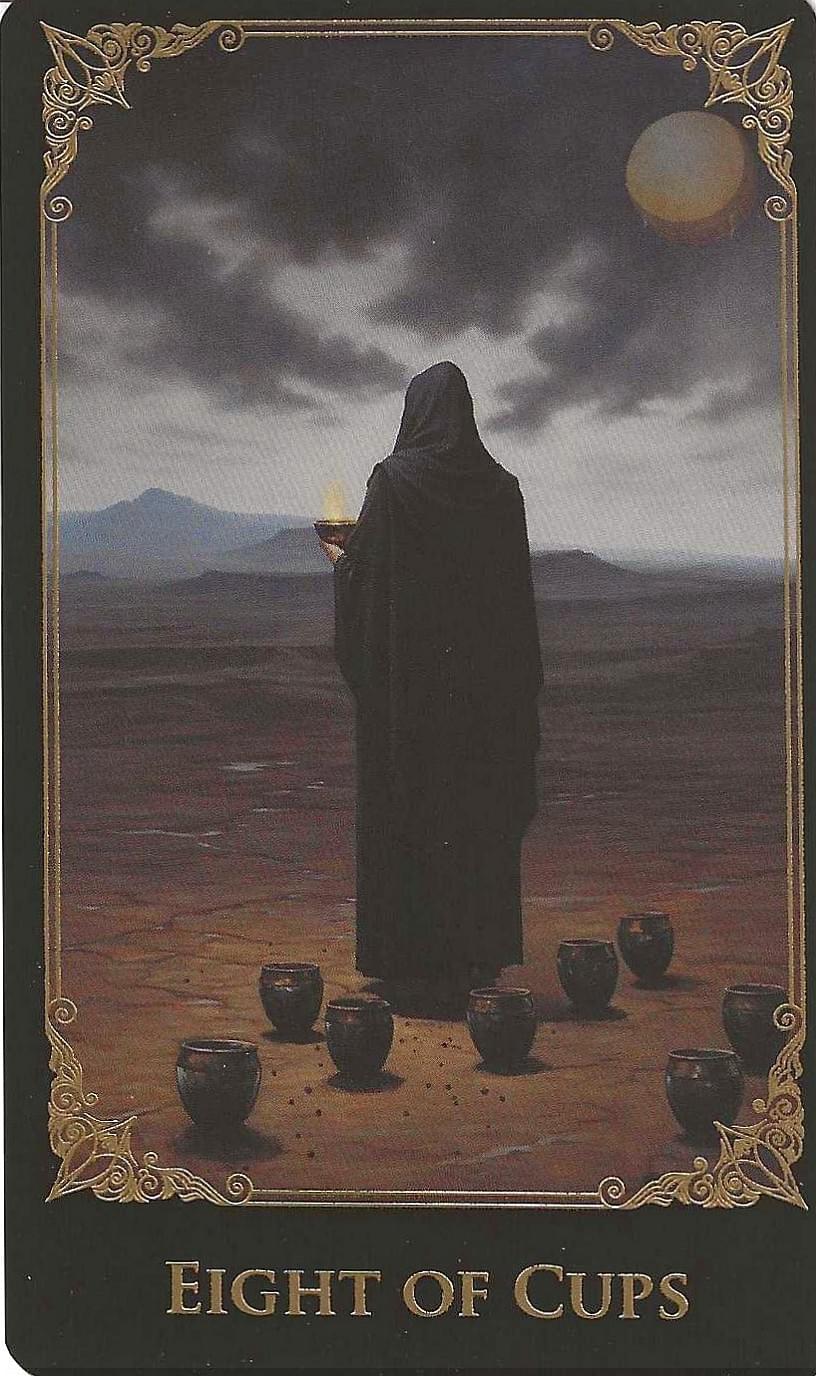
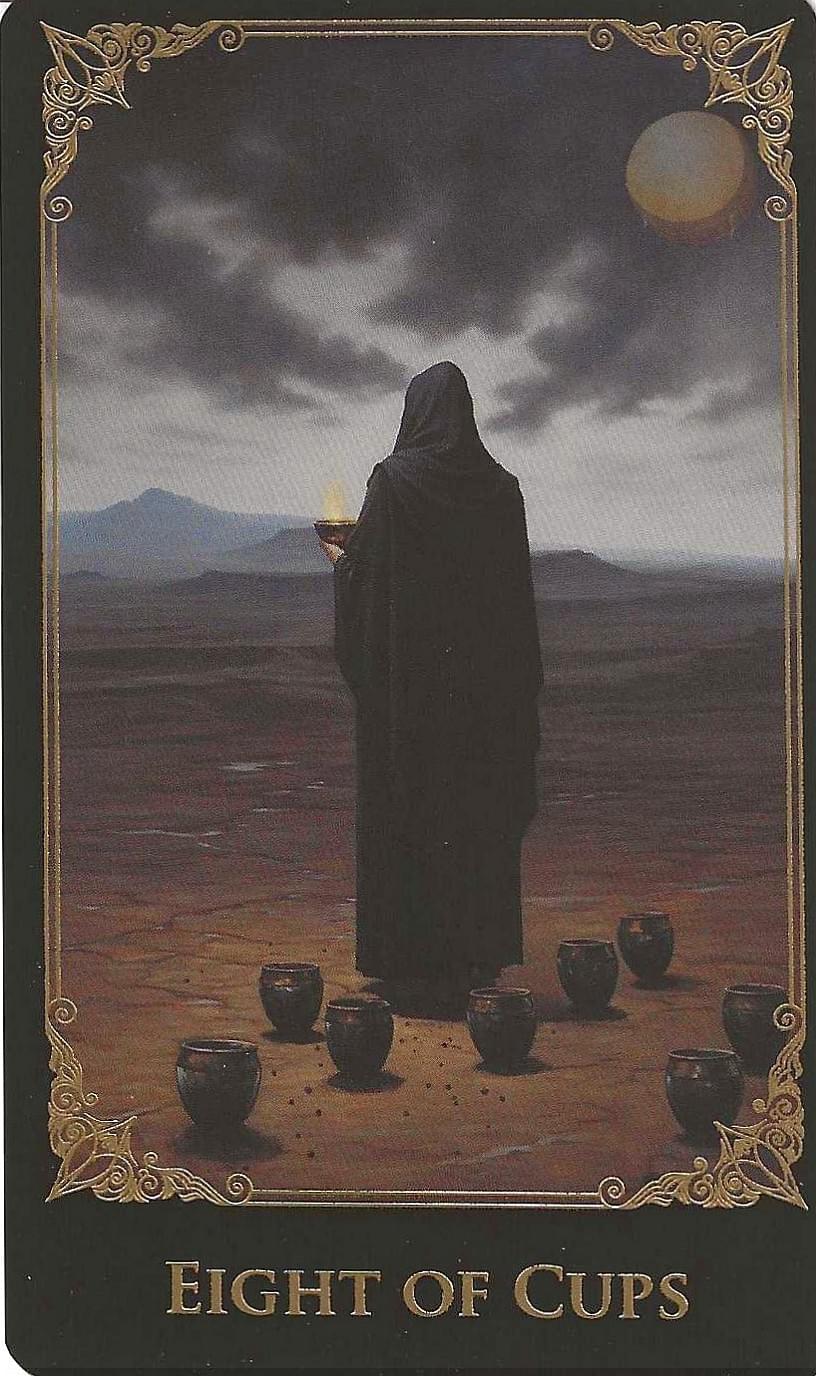
The Baroque Tarot-Eight of Cups
4. The Baroque Eight of Cups — The Courage to Abandon the Familiar
The Baroque Tarot approaches the Eight of Cups through a more traditional visual narrative, recalling the Rider–Waite–Smith interpretation of departure and disillusionment.
A dark-robed, hooded figure stands with its back toward the observer, contemplating a barren landscape.
The figure carries a vessel containing flaming oil.
Behind the traveler rest eight pottery cups.
The scene communicates abandonment, introspection, spiritual searching, and the difficult decision to leave familiar circumstances.
Unlike the Thoth image, in which the vessels remain trapped within stagnant conditions, the Baroque figure has begun separating from the old emotional arrangement.
The individual recognizes that something essential is missing.
The cups may represent accomplishments, relationships, possessions, expectations, or experiences that once provided satisfaction.
Yet their presence no longer guarantees fulfillment.
One can possess eight perfectly respectable cups and still discover that none contains what the Soul is seeking.
The Baroque figure therefore represents the seeker who understands that outer completeness does not always produce inner fulfillment.

The Flaming Vessel — Consciousness Carried into the Unknown
The flaming oil carried by the traveler provides a powerful opportunity for Hermetic interpretation.
Fire traditionally represents Will, transformation, illumination, and the activating power of Spirit.
Oil suggests fuel, consecration, and sustained illumination.
Together, they may be interpreted as the individual's determination to preserve an inner spiritual flame while passing through unfamiliar emotional territory.
The surrounding landscape may be dark, but the traveler carries a source of illumination.
This symbolism recalls the Hermetic understanding that spiritual development requires the conscious union of Will and experience.
The traveler is not merely escaping disappointment.
The individual is seeking a condition in which consciousness can express itself more authentically.
The cups have been left behind, but the Light has not.
In this sense, the Baroque Eight of Cups represents an important stage of initiation.
The aspirant discovers that remaining loyal to the Higher Self may require abandoning circumstances that once seemed indispensable.
This is not necessarily rejection of others.
It is recognition that spiritual growth sometimes requires a different environment, relationship, responsibility, or direction.
After all, one cannot discover a new horizon while insisting that the old horizon remain directly in front of one's nose!
5. The Path of Qoph — The Moon and the Journey through the Subconscious
Pisces is associated with the Hebrew letter Qoph (ק) and the Thoth Tarot's ATU XVIII — The Moon.
Within the familiar Golden Dawn arrangement of the Tree of Life, Qoph is the Twenty-Ninth Path, connecting Netzach (Victory) with Malkuth (Kingdom).
The Moon represents the mysterious passage through instinct, dreams, uncertainty, subconscious imagery, and the changing appearances of reality.
Its illumination is reflected rather than direct.
Consequently, the traveler must learn to distinguish meaningful intuition from fantasy, fear, projection, and inherited emotional conditioning.
Qoph is not the direct path of Hod, but the Piscean attribution establishes an important symbolic relationship with the Eight of Cups.
The emotional stagnation associated with Saturn in Pisces may require the individual to confront subconscious assumptions that have become obstacles to growth.
The traveler must ask:
Am I remaining because this situation nourishes my Soul?
Am I remaining because I fear the unknown?
Have I confused emotional familiarity with spiritual truth?
Am I pursuing a genuine calling or escaping responsibilities that still require attention?
These questions are particularly important because departure and avoidance can appear remarkably similar from the outside.
Walking away is spiritually meaningful when guided by discernment, not merely by discomfort.
The Moon teaches that the path toward greater consciousness may initially appear uncertain.
Yet uncertainty is not necessarily evidence that one has chosen incorrectly.
Sometimes the familiar road ends because a new road must be discovered.
6. The Alchemy of Indolence — Nigredo, Albedo, and Rubedo
The Eight of Cups also reveals an alchemical process of psychological and spiritual transformation.
Its imagery corresponds particularly well with Nigredo, the Blackening.
Nigredo — The Blackening
Nigredo represents decomposition, darkness, dissolution, and the breakdown of an existing arrangement.
In the Eight of Cups, this condition appears as emotional stagnation and the deterioration of once-meaningful patterns.
The personality discovers that its former methods of obtaining fulfillment no longer produce the desired results.
This can be uncomfortable, but dissolution is not necessarily destruction.
In alchemical symbolism, decomposition prepares matter for transformation.
The old form must sometimes lose its apparent perfection before its hidden potential can emerge.
Albedo — The Whitening
Albedo symbolizes purification, clarification, and the separation of essential qualities from accumulated confusion.
In the Eight of Cups, Albedo begins when the individual honestly examines the causes of dissatisfaction.
What is genuinely necessary?
What has become habitual?
Which responsibilities remain meaningful?
Which emotional attachments no longer support growth?
Through discernment, the waters of consciousness begin to clear.
Rubedo — The Reddening
Rubedo represents integration, renewed vitality, and the manifestation of transformed consciousness.
In the Eight of Cups, Rubedo may appear when the individual acts upon newly discovered understanding.
A relationship is renewed through honesty.
An exhausted creative practice receives fresh inspiration.
A harmful pattern is abandoned.
A meaningful new direction is pursued.
The individual no longer merely contemplates transformation.
The individual becomes an active participant in transformation.
The alchemical lesson is simple:
Nigredo reveals what has become exhausted. Albedo clarifies what must change. Rubedo gives the renewed Will a living expression.
Even the Philosopher's Stone requires some work.
Apparently, the Great Work does not come with a reclining chair and unlimited room service!
7. The Poisoned Soil — The Subconscious Garden
The poisoned ground of the Thoth Eight of Cups and waste land of the Baroque card can be understood as a metaphor for the subconscious conditions in which habitual thoughts and emotional responses develop.
Within Western Hermetic symbolism, the human personality is not merely a collection of isolated thoughts.
It is an organized interaction among instinct, emotion, memory, imagination, intellect, and conscious Will.
The subconscious preserves patterns through repetition.
These patterns may support growth, but they can also perpetuate outdated reactions.
When emotional experiences become rigidly associated with fear, disappointment, or hopelessness, the personality may repeatedly interpret new circumstances through old assumptions.
The result is a symbolic poisoning of the inner soil.
New possibilities are present, but the individual struggles to recognize them.
Three Requirements for Renewing the Inner Garden
1. Sunlight — Tiphareth and the Solar Self
Tiphareth, the Sixth Sephirah, represents Beauty, harmony, and the Solar principle.
In the Hermetic interpretation of the Higher Self or Holy Guardian Angel, Tiphareth symbolizes an integrating center of awakened consciousness.
Meditation, contemplation, devotion, and deliberate self-examination can help the aspirant reconnect with a broader sense of identity and purpose.
2. Water — The Renewal of Emotional Movement
Water represents the living movement of feeling, receptivity, and imagination.
Through creative expression, companionship, honest communication, music, and meaningful rest, emotional experience can regain flexibility.
Yesod, the Ninth Sephirah, provides an especially useful symbolic correspondence through its association with the formative and imaginal foundations of experience.
3. Cultivation — Hod and the Reorganization of Thought
The intellectual faculty must participate in renewal.
Old assumptions require examination.
Unfinished responsibilities may need attention.
New habits must be consciously established.
The poisoned soil is restored through repeated acts of awareness and constructive change.
The Soul may provide the inspiration, but somebody still has to pull the weeds!

8. Numerology and Gematria — The Mystery of Eight
The number Eight carries important associations within Western Hermetic Qabalah, Hebrew Gematria, and modern numerology.
However, these systems should be distinguished rather than treated as identical.
Eight and Hod
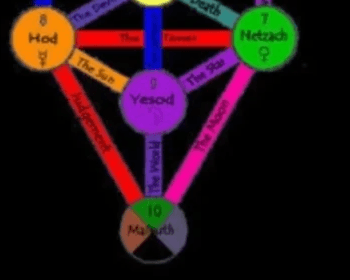
On the Tree of Life, Eight corresponds to Hod.
Hod represents intellectual structure, symbolic interpretation, analysis, and the organization of information.
Its healthy expression creates clarity.
Its unbalanced expression may become excessive analysis, rigidity, or mental repetition.
In the Eight of Cups, Hod's organizing ability operates within an emotionally exhausted environment.
The intellect may continue constructing explanations for circumstances that the Soul has already outgrown.
Sometimes the mind becomes remarkably skilled at explaining why nothing can change.
And it can produce a forty-page report proving it!
Eight and the Hebrew Letter Chet
In Hebrew Gematria, the letter Chet (ח) has the numerical value Eight.
Chet begins the Hebrew word Chai (חי), meaning life.
Chai combines Chet (8) and Yod (10), producing the numerical value eighteen.
This association provides a meaningful symbolic contrast to Indolence.
The number Eight can suggest organized vitality, while the Eight of Cups depicts an arrangement in which vitality has become constrained.
This is a numerological meditation, however, rather than a direct attribution of Chet to the Eight of Cups. In the Tarot's Hebrew-letter correspondences, Chet belongs to the Chariot.
Eight in Modern Numerology
Modern numerology often associates Eight with:
Organization and executive responsibility.
Material achievement and practical authority.
Discipline and perseverance.
The ethical exercise of power.
The relationship between actions and consequences.
The horizontal figure-eight, or infinity symbol, provides an additional image of continuity and recurring movement, although this association should not be confused with the historical meaning of Hebrew Gematria.
In the Eight of Cups, these qualities encounter a difficult question:
What happens when discipline continues after meaningful purpose has disappeared?
The answer is Indolence.
Work may continue, yet inspiration is absent.
Responsibilities may be fulfilled, yet fulfillment itself remains elusive.
The number Eight reminds us that organization without living purpose can become another form of imprisonment.

. The Parapsychological and Metaphysical Perspective — When the Inner Signal Becomes Faint
From a metaphysical perspective, the Eight of Cups may be interpreted as a disturbance in the relationship between conscious attention, emotional responsiveness, and the intuitive life.
The individual experiences a diminishing sense of connection with meaningful possibilities.
In Hermetic language, this might be described as weakened receptivity to the creative influence of the Higher Self.
From a psychological perspective, similar experiences may involve emotional exhaustion, habituation, stress, reduced motivation, or difficulties with attentional flexibility.
These descriptions concern different explanatory frameworks and should not be mistaken for proof that a measurable spiritual energy has been blocked.
Nevertheless, the symbolism is useful.
Imagine consciousness as an instrument capable of responding to many forms of experience.
Through repetition, the instrument may become increasingly responsive to familiar patterns while overlooking alternative interpretations.
The Eight of Cups encourages a deliberate interruption of this automatic process.
Instead of asking, "Why does this always happen to me?"
Ask:
"What am I repeatedly doing, expecting, or assuming that keeps producing a similar experience?"
This question returns responsibility to conscious awareness.
It also opens the possibility of meaningful change.
In my own Hermetic terminology, emotion is energy-in-motion.
When emotional experience becomes trapped in habitual interpretations, it may feel as though the energy itself has stopped moving.
Yet the opportunity for renewed movement remains.
A change of perspective can sometimes begin a change of experience.
10. Cosmology and Theology — The Living Universe and the Journey of the Soul
Within the Hermetic worldview, the individual human being is a Microcosm expressing principles reflected in the Macrocosm.
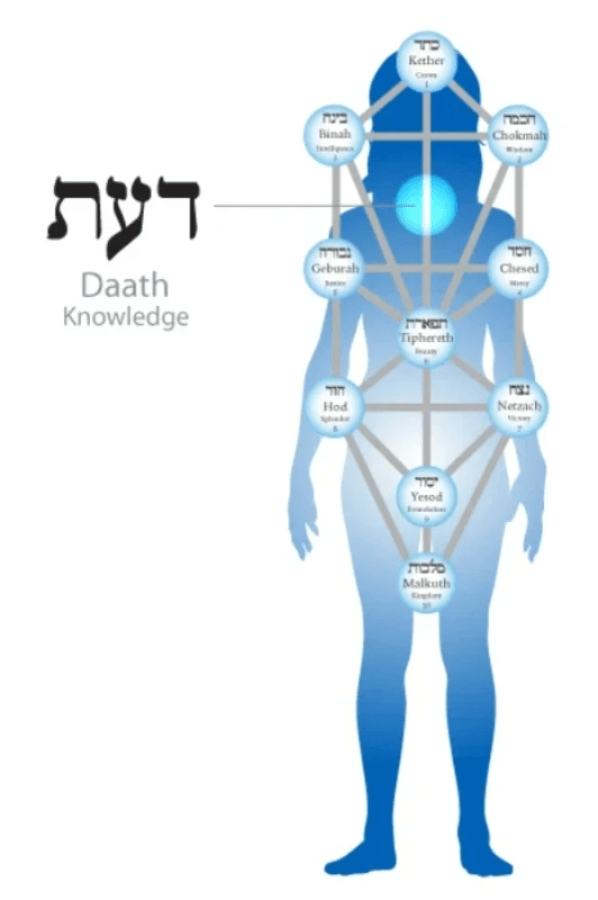
The Tree of Life symbolizes this relationship between universal order and individual consciousness.
The Eight of Cups represents a localized experience of disruption within that symbolic order.
The personality has become overly identified with a particular arrangement of circumstances.
The Soul, however, continues seeking a fuller expression of its possibilities.
Theologically, this recalls the recurring theme of departure found throughout sacred literature.
Abram leaves familiar territory in response to a divine calling.
The Israelites depart Egypt, exchanging familiar captivity for the uncertainties of freedom.
The mystic leaves behind limiting identifications in pursuit of spiritual realization.
These narratives differ historically and theologically, but they share a useful symbolic pattern:
Transformation frequently requires departure from an established condition.
The Eight of Cups expresses this principle at the level of personal experience.
One may leave a physical place, an emotional dependency, an outdated belief, or an exhausted understanding of oneself.
The essential departure is inward.
It involves releasing identification with a condition that no longer expresses the individual's developing consciousness.
From the Hermetic perspective, the Soul does not necessarily seek what the personality finds comfortable.
It seeks experience through which awareness may become more complete.
Consequently, the path of spiritual development can lead through unfamiliar territory.
This is not punishment.
It is the challenge of growth.
As the old saying might be adapted for our present purposes:
The Divine may provide the road, but it rarely promises that every mile will have a coffee shop!

11. Indolence, Emotional Overload, and the Importance of Humor
One of the most important teachings of the Eight of Cups is that apparent inactivity is not always laziness.
Sometimes an individual has become emotionally overwhelmed.
Too many responsibilities, unresolved disappointments, competing demands, or prolonged pressures may leave the personality exhausted.
Under such circumstances, even minor tasks can appear enormous.
The individual may withdraw, procrastinate, or lose interest in activities that previously provided satisfaction.
The Eight of Cups invites us to examine this condition honestly.
Is genuine rest required?
Has a situation become unsustainable?
Are responsibilities being avoided because of fear?
Has the personality continued pursuing something that no longer holds meaningful value?
These questions deserve compassion as well as discipline.
Rest is not Indolence. Conscious rest restores vitality; Indolence represents a pattern of disconnection from meaningful engagement.
Sometimes the most spiritually intelligent action is to stop, sit beside a creek, remove one's shoes, and soak one's tired feet.
Life requires both movement and repose.
Even the most dedicated Magus must occasionally remember that the physical body is a living partner in the Great Work, not an employee expected to work twenty-four hours a day without lunch!
Humor also has an important role.
When every difficulty is classified as a catastrophe, the mind can become imprisoned by exaggerated seriousness.
Humor introduces perspective.
It allows us to distinguish between what genuinely requires attention and what has become unnecessarily intimidating.
Not every inconvenience is an approaching apocalypse.
Sometimes the universe is not testing your initiation.
Sometimes you simply misplaced your car keys.
12. Act Now, Not Later — Reclaiming the Spiritual Will
The Eight of Cups also teaches the importance of conscious action.
Repeated procrastination can create a growing accumulation of unresolved responsibilities.
Each unfinished task may occupy attention, increasing the sensation of being overwhelmed.
Eventually, the personality resembles a heavily burdened dromedary carrying every neglected obligation across the desert.
And still somebody asks the poor camel to carry one more suitcase!

The remedy begins with a practical distinction.
Not every problem must be solved immediately, but every problem can be consciously acknowledged and assigned its appropriate place.
Choose one manageable responsibility.
Complete it, schedule it, delegate it where appropriate, or deliberately decide that it is unnecessary.
This simple practice interrupts automatic avoidance.

In Hermetic terms, it represents the restoration of conscious Will over habitual reaction.
Reaction is often conditioned by previous experience.
Conscious action introduces deliberation and choice.
The physical organism naturally responds to stimuli, but the developing personality can learn to examine those responses before acting.
The aim is not to eliminate instinct or emotion.
It is to bring them into cooperation with awareness.

The Hermetic Declaration
I AM the Solution!
Not because every circumstance is under my control.
Not because every disappointment can be instantly reversed.
But because I can consciously participate in determining my next appropriate action.
I AM the Will that chooses.
I AM the Awareness that examines.
I AM the Living Soul that learns through experience.
I AM not imprisoned by yesterday's emotional conclusions.
The Eight of Cups reminds us that conscious action may begin with something remarkably small.
One honest conversation.
One unfinished responsibility completed.
One unnecessary obligation released.
One moment of genuine rest.
One decision to stop repeating an exhausted pattern.
Sometimes one small movement is sufficient to interrupt an enormous amount of inertia.
13. The Eight of Cups in a Tarot Reading
When the Eight of Cups appears in a Tarot reading, it commonly indicates that an emotional situation has reached a point of transition.
The querent may recognize that something once meaningful no longer provides the same satisfaction.
This does not automatically require abandonment.
It requires honest evaluation.
When Well Dignified by Surrounding Cards
The Eight of Cups may indicate:
Recognition that a relationship, project, or emotional arrangement has become exhausted.
The courage to leave an unfulfilling situation.
A period of introspection and spiritual reassessment.
The release of outdated attachments.
Emotional withdrawal for necessary reflection or recuperation.
A growing desire for greater authenticity.
The discovery that spiritual development may require unfamiliar experiences.
The completion of one emotional chapter and preparation for another.
Renewed attention to neglected emotional or spiritual needs.
The realization that meaningful fulfillment cannot always be obtained through familiar methods.
When Ill Dignified by Surrounding Cards
The Eight of Cups may suggest:
Emotional stagnation and prolonged dissatisfaction.
Avoidance of necessary decisions.
Self-pity or excessive identification with disappointment.
Resistance to meaningful change.
Withdrawal from supportive relationships.
Abandonment of responsibilities without adequate reflection.
Confusion regarding spiritual purpose.
Difficulty recognizing opportunities for renewal.
Exhaustion that interferes with ordinary activities.
A tendency to remain in circumstances that no longer support growth.
When emotional exhaustion is accompanied by persistent hopelessness, severe withdrawal, or loss of ordinary functioning, practical support and professional assessment may be appropriate. A Tarot card cannot diagnose depression or establish suicidal risk.
Timing
In traditional Tarot timing practices, the number Eight may symbolically suggest eight days, weeks, or months, depending upon the surrounding cards, the question, and the reader's established method.
Astrologically, Saturn in the first decan of Pisces corresponds approximately to February 19–28, with dates varying slightly by year.
These associations are interpretive conventions rather than guaranteed predictions.
The surrounding cards help determine whether the emphasis concerns immediate action, a developing emotional process, or the longer-term consequences of existing choices.
14. The Final Hermetic Teaching — When the Cups Are Empty, Seek the Living Water
The Baroque and Thoth Eight of Cups present two stages of one transformative experience.
The Thoth card reveals the exhaustion of an emotional condition.
The Baroque card reveals the willingness to seek something beyond that condition.
Together, they illustrate the necessity of conscious renewal.
Saturn in Pisces teaches that spiritual imagination must be supported by discernment.
Hod in Briah teaches that intellectual structure must remain responsive to living inspiration.
The alchemical Nigredo teaches that the deterioration of an old form may prepare the way for transformation.
Qoph and the Moon remind the aspirant that meaningful change sometimes requires passage through uncertainty.
And the Solar principle of Tiphareth reminds us that the Higher Self is not necessarily diminished simply because the personality has temporarily lost its sense of direction.
The Soul's Light does not cease to exist because the clouds of experience obscure its appearance.
Therefore, the Eight of Cups does not demand that we despise the past.
It asks us to recognize when the past has completed its instruction.
Nor does it demand constant activity.
Sometimes rest is precisely what makes renewed activity possible.
The spiritual aspirant learns to distinguish exhaustion from avoidance, responsibility from unnecessary burden, and meaningful loyalty from fear of change.
Above all, the Eight of Cups teaches us that the life of the Soul is a process of continual revelation.
We experience.
We learn.
We release.
We renew.
And we continue.
Remember, there is no spiritual virtue in endlessly drinking from an empty cup while complaining that the universe has forgotten to refill it.
Sometimes the wisest thing a Magus can do is put down the cup, thank it for its service, and walk toward the living spring.
Above all things, know thyself.
And when necessary, know when to leave!

A Closing Blessing
Thank you for your interest, thoughtful comments, and supportive donations. Your generosity helps keep the living waters of Western Hermetic wisdom flowing for seekers everywhere.
May the stagnant waters of yesterday give way to the clear streams of renewed inspiration. May Saturn grant you wisdom without unnecessary burdens, Pisces grant you compassion without surrendering your sovereignty, and the Solar Light of Tiphareth illuminate every step of your spiritual journey.
May you always possess the courage to release what has completed its purpose and the wisdom to recognize what deserves your continued devotion.
May your cups overflow with living inspiration, your feet find the path of your Higher Self, and your Soul never forget how to laugh!
May you live long and prosper!
— Magus Eli
The Tarot of Eli, LLC
Thoth Master Class: Western Hermetic Qabalah & Tarot
One-on-One Esoteric Training with Magus Eli
Awaken Your Resonance with the Thoth Tarot
This is not an ordinary Tarot class. The Thoth Master Class is a personalized journey into Hermetic Qabalah and the mysteries of the Thoth Tarot, guided one-on-one by Magus Eli.
These sessions are designed to align your soul’s archetypes with the Tree of Life, blending mystical philosophy with hands-on Tarot practice for profound spiritual transformation.
What Makes This Class Unique?
Private Instruction: Just you and the Magus in a 2-hour Google Meet session — fully tailored to your goals.
Flexible Scheduling: Weekly, every two weeks, or monthly (12 sessions recommended for full mastery).
Recorded Lessons: Every session is recorded for your personal review and ongoing study.
Hermetic Depth: Learn Tarot as a gateway to the Tree of Life, elemental forces, and pathworking.
Practical Mastery: Practice Tarot layouts live with guided interpretation to build confidence and resonance.
What You’ll Learn
The structure of the Thoth Tarot: Major Arcana, Minor Arcana, and Court Cards
The Western Hermetic Qabalah: Ten Sephiroth, Four Worlds, and 22 Paths
Pathworking and meditative techniques using Tarot as a key to inner temples
Hermetic spreads and ritual applications for personal transformation
Developing personal gnosis and building your own mystical framework
Required Materials
The Qabalistic Tarot: A Textbook of Mystical Philosophy by Robert Wang
Thoth Tarot deck (Crowley/Harris edition preferred)
Personal journal or Book of Shadows
Is This Class for You?
No prior Tarot experience is required — beginners and advanced seekers are welcome.
Perfect for anyone drawn to Hermetic wisdom, deep archetypal work, and personal gnosis.
How to Enroll
Email eli@elitarotstrickingly.com to request availability and begin your personalized resonance mapping session.
Call to Action
Awaken the archetypes within. Enter the living mysteries of the Thoth Tarot. Begin your Master Class today. Inquire about sliding scale prices available so that these classes can be affordable to all aspirants.
3 Western Hermetic tarot and magick websites helping people become more magic and less tragic since 2010
For information concerning a personal online Thoth Tarot Reading and/or Thoth Qabalistic Tarot Master classes, Thoth Tarot Card Decks, book of Thoth-log onto-elitarotstrickingly.com- and click on the Tarot/Store page. Thank you.
Traditional Tarot Card Blog (Rider-Waite-Smith comparisons) and tarot store with RWS Tarot Cards and Tarot books.
Western hermetic magick ritual and invocation website and magick blog.
