
elitarotstrickingly.com
Above all things, know thyself.
A Western Hermetic Qabalistic Tarot Card Comparison Critique.

The Fool-The Baroque Tarot-Front and back of card

Thoth- ATU 0- The Fool (Atu 22)
The Primal Breath of Spirit and the Mystery of Divine Potential
The Thoth Tarot, created by Aleister Crowley and painted by Lady Frieda Harris between 1938 and 1943, is one of the most profound and symbolically dense Tarot decks ever produced. Crowley supplied the Hermetic, Qabalistic, astrological, and magical doctrines, while Harris translated those ideas into luminous, visionary art. Together, they produced a deck that is not merely a tool of divination, but a living glyph of Western Hermetic Qabalah, Thelemic philosophy, and the Great Work of self-realization.
Every card in the Thoth Tarot speaks in symbols. Its imagery is built from Qabalah, astrology, alchemy, mythology, sacred geometry, and magical philosophy. The cards are not isolated pictures; they are interconnected currents on the Tree of Life, showing the journey of consciousness from divine source into manifestation and back again.

The Major Arcana may be understood as the grand map of the Soul’s journey, while the Minor Arcana represents the terrain encountered along the way: Fire, Water, Air, and Earth; will, emotion, thought, and material experience. In this sense, Tarot is truly the alphabet of the Soul. Each card is a letter, word, vibration, or sentence in the story of consciousness becoming aware of itself.
At the center of this entire system stands The Fool — Atu 0.

The Fool as the Beginning and End of the Soul’s Journey
The Fool is the most esoteric of all the Tarot cards because every card in the deck is, in some way, an expression of The Fool. The entire Tarot may be seen as 78 aspects of the psyche, all unfolding from the primal mystery of Atu 0.
The Fool is the beginning and the end. He is the unborn Soul before incarnation, the divine spark entering experience, and the awakened consciousness returning to its source. He is the hero, the heroine, the wanderer, the mad one, the divine child, and the cosmic adventurer who steps into existence without fear because he belongs to the infinite.

In Western Hermetic Qabalah, The Fool is assigned to the Path of Aleph, the first Hebrew letter. Aleph means Ox, symbolizing primal force, breath, life-power, and the silent strength that moves creation. This path connects Kether, the Crown, with Chokmah, Wisdom. Therefore, The Fool represents the first movement of the Limitless into divine impulse.

Kether is the Source, the pure “I Will Be” of Eheieh. Chokmah is the first surge of Wisdom, the Father principle, the dynamic force of divine projection. Between them flows Aleph: the Breath of Spirit, the silent current of Life before form has yet appeared.
This is the mystery of 0 becoming 2.

Aleph, Breath, and the Scintillating Intelligence
Dr. Paul Foster Case (B.O.T.A.) called the Path of Aleph the Scintillating Intelligence, which is a fitting phrase for this first flash of living potential. The Fool borders the realm of the Ain Soph, the Limitless Light beyond form, mass, and measurement. To the human mind, this Limitless Light appears as darkness, because we cannot perceive what has no boundary.

Thus, The Fool is not merely “nothing.” He is No-Thing: the infinite potential before manifestation. He is the unmeasured field from which all measurement arises.
The Fool is the possibility of vibration before vibration is known. He is the silent breath before speech. He is the first stirring of divine awareness before the Logos becomes the Word. In metaphysical language, he may be compared to the uncollapsed wave of pure potential, the dark womb of possibility from which thought, light, and form arise. The Superposition of I AM.
Here reason reaches its limit. The infinite cannot be confined by the intellect. It must be entered by symbol, dream, intuition, and gnosis. This is why Tarot is so valuable. Tarot speaks the language of the Soul before the rational mind reduces mystery into fixed definition.

The Fool and the Divine Dream
The Fool also represents the Divine Dreaming itself. Before manifestation, the universe exists as potential within the Divine Mind. This can be compared to the image of Vishnu in Yoganidra, the cosmic sleep, dreaming the worlds into being upon the serpent Ananta in the cosmic ocean.

In this image, the sleeping Vishnu represents unmanifest potential, while the awakened Vishnu represents active manifestation. Likewise, The Fool is both the dreamer and the beginning of the dream. He is the sleeping seed of consciousness and the sudden leap into experience.

In the human body, this mystery may be compared to the latent Kundalini force resting at the base of the spine. The sleeping divine power becomes the awakened consciousness when it rises, acts, observes, and transforms the dream of incarnation.
This is the true power of The Fool: he does not merely enter the world; he changes the world by observing it. The Fool is the lucid dreamer within the divine dream.
The Fool, Daath, and the Birth of “I AM”
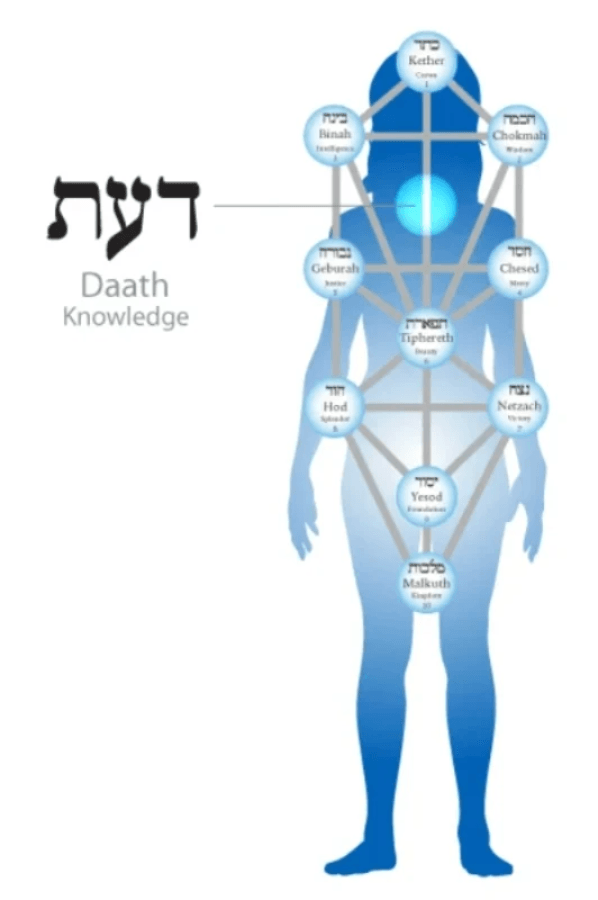
In Qabalistic metaphysics, the mystery of identity begins before ordinary selfhood. Kether is the pure “I.” Chokmah is dynamic Wisdom. Binah is Understanding, the Great Mother who gives form to force. When Wisdom and Understanding meet, knowledge arises in the invisible Sephirah of Daath.
Daath is the threshold of divine knowledge, the meeting place of God and Goddess, Father and Mother, Wisdom and Understanding. It is the mystical womb where the image of God becomes knowable. Here the “I” begins to become “Am.”
The Fool stands before this entire process. He is not yet fixed identity. He is the free, radiant, unconditioned potential that later becomes personality, ego, body, memory, and destiny. The mundane self says, “I am me.” The higher Self knows, “I AM.”

This is why The Fool must be approached with a sense of sacred humor. The closer one comes to Kether, the more the personal self dissolves. The ego wants to understand the divine mystery, but the divine mystery is what gives birth to the ego. Therefore, the wise Fool laughs. He knows that the “me” is a temporary mask worn by the eternal “I AM.” The Ego is his dog companion.
The Fool and Tetragrammaton
The Fool also contains the seed of Tetragrammaton, the sacred formula of YHVH. Crowley summarized this mystery as the union of Father and Mother producing Twins: the Son going forward to the Daughter, and the Daughter returning the energy to the Father. Through this cycle, the universe maintains continuity, transformation, and renewal.
In this formula:
Yod is the Father, primal fire and seed.
Heh is the Mother, the womb of understanding.
Vav is the Son, the solar mediator.
Heh final is the Daughter, manifestation in matter.
The Fool precedes and contains this formula. He is the One Energy before division, the 0 that becomes 2 and then becomes the many. He is the eternal current that cannot be created or destroyed, only transformed.
This is why the Fool is not merely a person. He is the principle behind every person. He is the divine wanderer wearing every face

The Symbolism of the Thoth Fool
The Thoth Fool is a riot of mythic and esoteric symbolism. Crowley and Harris present him not as a simple wanderer, but as the explosive emergence of creative life.
He bears the horns of Dionysus Zagreus, and between them rises a cone of white light, suggesting the influence of Kether. He bursts into the world clothed in the green of spring, wearing golden solar shoes, filled with the freshness of new life.
In his right hand he carries a wand tipped with a white pyramid, again suggesting Kether. In his left hand he holds the flaming pinecone, recalling the Thyrsus of Dionysus, a symbol of ecstatic life-force, vegetation, and awakened spiritual fire.
Around him spirals the creative whorl of life: grapes, rainbow forms, the dove, the vulture, the butterfly, the winged globe, twin serpents, twin infants, flowers, lotus stems, the Nile, the crocodile, and the tiger. Each symbol reveals a layer of the Fool’s mystery.

The tiger, representing fear, clings to his leg, yet the Fool is unaware of it. This is not ignorance in the ordinary sense; it is divine innocence. The Fool moves beyond fear because he has not yet agreed to be limited by it.

The crocodile beneath him recalls Sebek, the primal devourer and ancient instinctual power. The lotus and Nile suggest the fertile waters of manifestation. The butterfly symbolizes the Soul, transformation, and the airy movement of consciousness.

The entire card is a glyph of Creative Light emerging from invisible Darkness.

Dionysus Zagreus and the Scattered Divine Self
The horns of Dionysus Zagreus deepen the mystery. Zagreus is the Orphic Dionysus, the divine child of Zeus and Persephone, destined for cosmic inheritance. In the myth, the Titans dismember Zagreus, but Athena preserves his heart. Through this preserved heart, Dionysus is born again.
Hermetically, Zagreus is the Solar Self scattered into matter. His dismemberment represents the fragmentation of divine unity into the many forms of existence. The Titans represent separation, entropy, and the forces of division. Yet the heart remains untouched.
This is the mystery of incarnation. The Soul appears scattered through body, memory, trauma, desire, and experience, yet the divine heart remains intact. The Great Work is the recollection of that hidden heart.
Zagreus teaches that descent into matter is not a punishment. It is an initiation. The body is not the enemy of Spirit. The body is the temple in which the divine spark is remembered.
Thus, The Fool is the divine child before fragmentation, and Zagreus is the divine child after fragmentation. Together, they reveal the journey of the Soul into matter and its return through gnosis.

Zero, Gematria, and Infinite Potential
In traditional Hebrew Gematria, there is no numerical letter for zero. Aleph begins the alphabet and carries the value of 1. Yet in Western Hermetic Qabalah, the idea of zero is mystically linked to Ain, Ain Soph, and Ain Soph Aur: Nothing, Limitlessness, and Limitless Light.
Zero is not empty in the ordinary sense. It is the womb of all numbers. It is the unmanifest source from which all manifestation emerges. It is both nothing and everything, the circle of completion and the seed of beginning.
In numerology, zero amplifies the number beside it. In Tarot, The Fool as 0 amplifies the entire deck because he is the unbounded source of all Tarot symbolism. He is not one card among many; he is the field from which the many cards arise.

Uranus and the Fool’s Eccentric Freedom
The Thoth Fool is also associated with Uranus, the planet of awakening, disruption, originality, rebellion, and sudden transformation. Uranus breaks old structures so that new consciousness can emerge. It is the lightning of liberation.

This Uranian quality gives The Fool his eccentricity. He is unpredictable because pure Spirit cannot be controlled by convention. He does not obey the fixed patterns of society, ego, or fear. He leaps, wanders, laughs, risks, and discovers.
Uranus is the Great Awakener, and The Fool is the one willing to be awakened. He moves beyond stale patterns, outdated identities, and inherited limitations. He is the spiritual revolutionary of the Tarot.
Yet this does not mean foolish recklessness in the shallow sense. The sacred Fool is not merely careless. He is free because he is aligned with a deeper current than ordinary caution. He trusts the unknown because he is born from the unknown.
Mundane Meaning in a Tarot Reading
In a Tarot reading, The Fool does not always indicate a lofty mystical initiation. Unless surrounded by highly spiritual cards or placed in a deeply spiritual position, The Fool often has a more practical meaning.
He may indicate a new beginning, a risk, a leap of faith, a journey into the unknown, or a need to trust life. He may also warn of naïveté, distraction, immaturity, or failing to see consequences.
The Fool asks: Are you moving from divine innocence or from careless ignorance? Are you answering the call of Spirit, or are you avoiding responsibility? Are you trusting the unknown, or merely wandering without awareness?
The answer depends on the surrounding cards and the consciousness of the querent.

Conclusion: The Mystery of the Soul
The Fool represents the true mystery of the Soul. Each of us is more unpredictable, vaster, and more divine than the personality admits. We do not always know what we will risk next, what we will become, or what strange road Spirit will ask us to walk.
And yet, we go forward.
We step into life, come hell or high water, trusting that somehow, we will muddle through. This is not merely human folly. It is divine adventure.
The Fool is the primal Self before the world names it. He is the Soul entering manifestation, the lucid dreamer within the cosmic dream, the divine child who laughs at fear, and the hidden 0 behind every number.
He is the beginning.
He is the end.
He is the leap.
He is the breath.
He is the sacred madness of Spirit becoming Life.
In the deepest Hermetic sense, we are all The Fool — and blessed are we when we are wise enough to know it.

.
The Tarot of Eli, LLC: The Baroque Tarot — 0 — The Fool
The Laughing Soul Entering the Light of Experience
The Baroque Tarot — 0 — The Fool presents a figure similar in spirit to the traditional Rider-Waite-Smith Fool, yet with its own dramatic tone. Here we see a laughing youth walking forward with his faithful dog companion beside him. Instead of carrying the familiar pole and satchel over his shoulder, this Fool carries a burlap bag filled with his possessions. The background is dark, yet the path before him is illuminated by light.

This image beautifully expresses the essential meanings of adventure, innocence, spontaneity, risk, and spiritual emergence. The Fool is moving from darkness into light, from the unknown into experience, and from potential into manifestation. He does not know all that awaits him, yet he walks with joy. This is the sacred innocence of the Soul before it becomes burdened by fear, doubt, and over-analysis.

In Western Hermetic Qabalah, The Fool is assigned to the Hebrew letter Aleph, meaning Ox. Aleph represents breath, life-force, silent strength, and the primal current of Spirit. As a path on the Tree of Life, The Fool connects Kether, the Crown, with Chokmah, Wisdom. Therefore, The Fool is the first movement of divine potential into creative impulse. He is not yet formed identity; he is the living breath of possibility.
The Baroque Fool’s laughter is important. It suggests that the Soul, before it is fully trapped in the seriousness of matter, still remembers its divine origin. This laughter is not foolishness in the shallow sense. It is the laughter of Spirit entering the cosmic play. The Fool laughs because, at the highest level, manifestation is a divine adventure.
The Fool as the Soul Before Experience
The Fool is numbered 0, making him the Tarot’s symbol of pure potential. Zero is not emptiness as absence; it is emptiness as unlimited possibility. In Qabalistic terms, zero points toward the mystery of Ain, Ain Soph, and Ain Soph Aur: No-Thing, Limitlessness, and Limitless Light.
Before the Soul enters the world of form, it exists as possibility. It has not yet been measured by name, body, memory, society, or personal history. The Fool is this unconditioned Soul, stepping from the invisible into the visible.
The Baroque Fool’s dark background emphasizes this mystery. Darkness here is not evil. It is the womb of the unknown, the hidden field of unmanifest life. The lighted path before him is the dawning of consciousness. He walks from the cosmic unknown into the illuminated road of incarnation.
Metaphysically, this shows the movement from potential to experience. The Fool is not carrying certainty. He is carrying his possessions, his instincts, his innocence, and his willingness to discover.
The Burlap Bag and the Burden of Incarnation
In the Rider-Waite-Smith Fool, the small satchel tied to a pole suggests hidden spiritual inheritance. In the Baroque Tarot, the Fool carries a burlap bag filled with his possessions. This makes the symbolism more earthy and practical.
The burlap bag represents the simple equipment of incarnation: tendencies, memories, karmic impressions, instincts, talents, and unfinished lessons. The Fool does not yet know the full meaning of what he carries. Like every Soul entering life, he brings inner contents that will unfold through experience.
From a parapsychological viewpoint, this bag may symbolize the subconscious storehouse. It contains impressions not yet brought into full awareness. These may include ancestral patterns, psychic sensitivities, emotional reflexes, dreams, and intuitive seeds. The Fool walks forward with this hidden content, and the journey of life will reveal what is inside.
This is why Tarot is so valuable. Tarot helps us open the symbolic bag of the psyche. It gives language to what the unconscious already knows.
The Dog as Instinct and Guardian
The faithful dog walking beside the Fool represents instinct, loyalty, animal intelligence, and the protective force of the subconscious. In many Fool cards, the dog either warns, encourages, or accompanies. In the Baroque Tarot, the dog strolls beside him, suggesting companionship rather than alarm.
This dog is the natural instinct of the body-soul. It is the animal wisdom that senses danger before the intellect explains it. It is also the friendly guardian of the path, reminding the Fool that innocence must still remain connected to instinct.
In Western Hermetic thought, Spirit does not reject the body. The animal nature is not the enemy. It is a necessary companion in manifestation. When trained by consciousness and illumined by Spirit, instinct becomes guidance rather than compulsion.
The Fool and the dog together show the union of divine innocence and natural intelligence.
The Dark Background and the Lighted Path
The Baroque Fool’s movement from darkness into light gives this card strong cosmological meaning. The universe itself may be understood as light emerging from darkness, form emerging from the unformed, and awareness emerging from the hidden depths of being.
The dark background suggests the Limitless, the unseen, the mystery before creation. The lighted path suggests the first visible road of becoming. The Fool does not need to see the entire path. He only needs enough light for the next step.
This is a profound spiritual teaching. The Soul rarely receives the whole map at once. It receives the next illumination, the next symbol, the next opportunity, the next leap. The Fool’s wisdom is trust in the unfolding path.

In Qabalistic language, this is the breath of Aleph moving from the supernal mystery toward manifestation. In metaphysical language, it is potential becoming experience. In cosmological language, it is the birth of light within the womb of space.
The Fool and the Hero’s/Heroin's Journey
The Fool begins the entire Major Arcana. Therefore, he is the hero or heroine before the trials begin. He has not yet met the Magus, the Priestess, the Empress, the Emperor, or the Hierophant. He has not yet faced love, death, temptation, collapse, judgment, or completion.
Yet all of these are hidden within him as potential.
This is why every Tarot card can be seen as an aspect of The Fool. The entire deck unfolds from his first step. The Major Arcana is the map of the Soul’s journey, while the Minor Arcana is the terrain: the fires of will, the waters of emotion, the airs of thought, and the earth of material life.
The Fool begins with innocence, but the journey will turn innocence into wisdom. That is the Great Work.
Upright Meaning
When upright, the Baroque Tarot Fool suggests a new beginning, a fresh journey, an open heart, and a willingness to enter life with wonder. It may indicate a leap of faith, an unexpected opportunity, or a time to trust the path even when the full road is not visible.
This card encourages spontaneity, but not stupidity. It asks the querent to remain open, curious, and alive to possibility. The Fool says: step forward, but keep your instincts awake.
Spiritually, the upright Fool shows the Soul answering the call of its own becoming. He is the breath before the word, the first step before the road is fully known.

Reversed Meaning
When reversed, The Fool warns against naïveté, recklessness, poor timing, or refusing to consider consequences. The same innocence that makes the Fool powerful can become dangerous when disconnected from awareness.
Reversed, this card may suggest foolish risk, immature behavior, careless choices, or wandering without purpose. It may also show fear of beginning, hesitation, or mistrust of one’s own path.
The reversed Fool asks for a more thoughtful approach. The light is present, but the traveler must learn to look where he is stepping.
Conclusion: The Sacred Laugh Before the Leap
The Baroque Tarot — 0 — The Fool is a powerful image of the Soul entering the path of life. The laughing youth, the faithful dog, the burlap bag, the dark background, and the illuminated road all reveal the mystery of consciousness moving from the unknown into experience.
He is innocent, but not empty. He carries hidden contents. He is joyful, but not yet wise. He walks into the light, but the darkness behind him remains the mystery from which he came.
In Western Hermetic Qabalah, The Fool is the breath of Aleph, the current between Kether and Chokmah, the primal movement of Spirit before form.
Metaphysically, he is pure potential. Parapsychologically, he is the psyche before its hidden contents are fully revealed. Cosmologically, he is light emerging from the infinite dark.
The Fool teaches that life begins as a leap, but wisdom is born from how we walk after the leap. He reminds us that the Soul did not come into manifestation merely to survive. It came to experience, awaken, laugh, risk, learn, and remember its divine origin.
Thus, the Baroque Fool walks forward into the light — and we, too, must follow the illuminated path of our becoming.

When thrown during a reading, the Fool represents.
- Ideas, thoughts, spirituality, and that which endeavors to rise above the material world.
- However, if the question of the querent is regarding a material event of ordinary life, this card is not well defined. Herein, it shows folly, foolishness, stupidity, eccentricity and even mania.
- The Fool is too ideal and unstable to be good in material things.
- The Fool is more about a willingness to "Throw oneself into the Abyss of the Unknown" rather than operating in a reasonable manner.
- Returning to the innocence of the "child within".
- The hero's or heroine's journey begins.
- Impetuousness.
- Unpredictability.
- Risk taking.
- Growth.
- Creativity.
- A jokester who loves to pull pranks.
- Creativity.
If surrounded by negative cards (Thoth) or if Reversed (The Baroque Tarot).
- You are having trouble committing to a relationship or project and just want to run away and do senseless things.
- The parrot's feather advises you to abandon old habits and adopt new ones that allow you to discover new things that you are curious about.
Thank you for your interest, comments, and free subscriptions. Your support keeps this work alive and helps me continue offering clear, meaningful Tarot and Western Hermetic Qabalah teachings.
If this work has brought you insight, inspiration, or greater self-awareness, please consider making an honest donation. Every dollar is appreciated, and every gift helps sustain the journey.
May you live long and prosper.
3 Western Qabalistic Magick websites assisting people in becoming more magic and less tragic since 2010.
