
#tarotthothqabalahmagickelitarotstrickingly.com
Above all things, know thyself!

Thoth- 7 of Swords-Futility
#7. Living from that will, supported by its unfailing wisdom and understanding, mine is the victorious life.
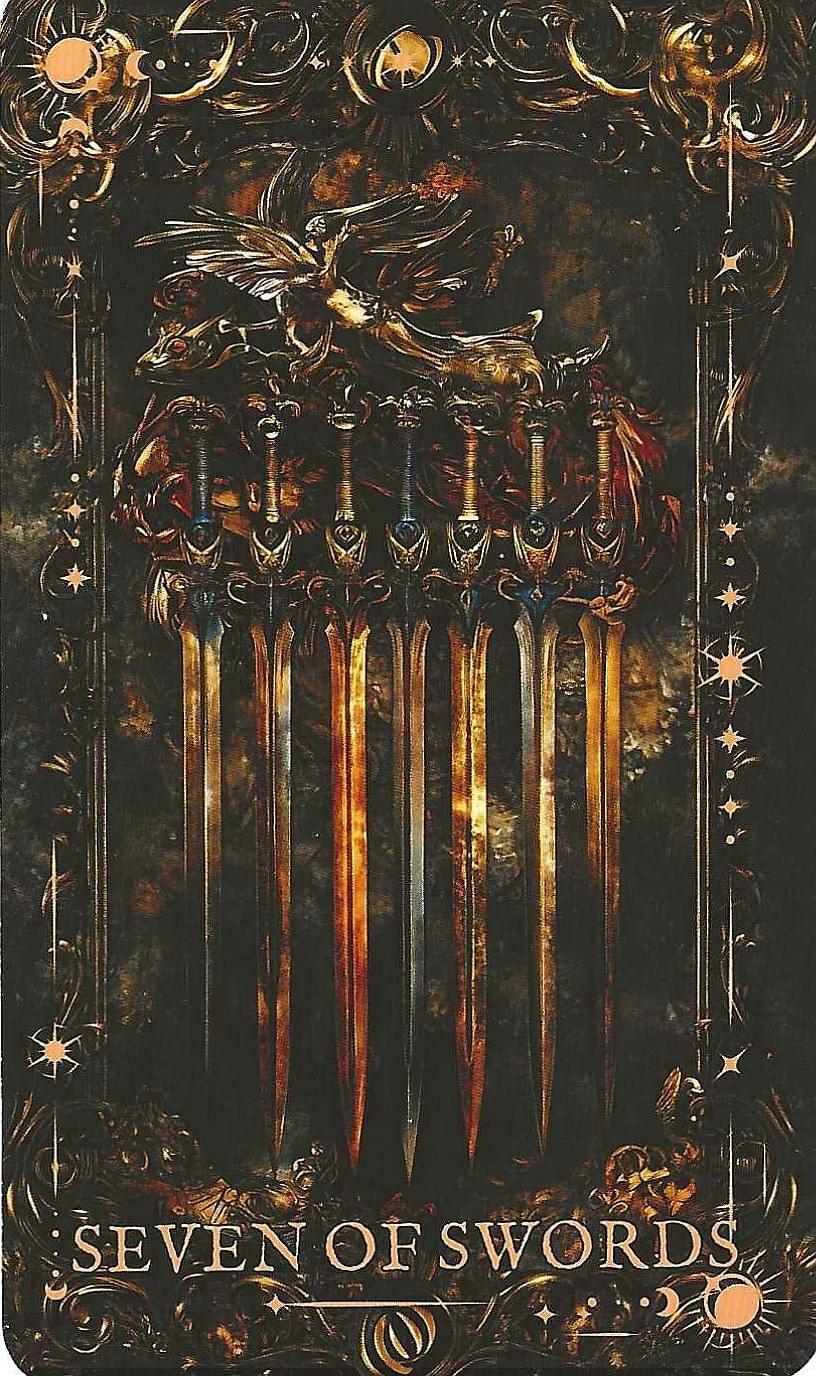
The Mystic Palette Tarot-7 of Swords

Thoth 7 of Swords — Futility
Moon in Aquarius, Netzach in Yetzirah, and the “Yes-But…” Saboteur
The Thoth 7 of Swords (Futility) maps the sabotaging mind with surgical precision. You can see the intention clearly: the central sword is what you truly want—your aim, your Solar directive. But surrounding it are six lesser swords, each one a competing rationale, a deflection, a delay, a “reasonable” explanation for why the desire cannot be embodied. This is the “yes-but…” mind:
Yes, I want it—but it’s too complicated.
Yes, I could—but I’m not ready yet.
Yes, I should—but I don’t have the energy.
The card doesn’t say you lack a dream. It says you have a dream—and you’re arguing yourself out of it.

Moon in Aquarius: emotion wearing a lab coat
Astrologically, the 7 of Swords is Moon in Aquarius. In the Thoth card, the crescent Moon above the sword tip announces the lunar current; the wavy line forms below signal Aquarius—the field of group-mind, social current, and “mental atmosphere.”
Moon in Aquarius can look like emotional detachment, but in practice it often means something subtler:
emotions routed through concepts
feelings expressed as analysis
vulnerability defended by distance
desire postponed by intellectualization
Aquarius wants freedom and futurity. The Moon wants safety and habit. Their union can produce brilliance—but also a peculiar trap: the mind becomes an emotional defense system, constructing elegant reasons to avoid the risk of incarnation.
That’s why this card is Futility: not because the goal is impossible, but because the inner committee keeps postponing the moment of action.

The Six Sabotage Swords: planetary “voices” on the hilts
Crowley and Harris give you a Hermetic diagnostic tool: the surrounding swords bear planetary glyphs—six common “voices” that sabotage the Solar aim. Each voice sounds practical. Each one is a spiritual procrastination dressed as logic.
1) Saturn — “It’s too complicated.”
Saturn is structure, responsibility, and time—yet its shadow voice becomes red tape and paralysis:
“There are too many steps.”
“I’ll do it when everything is perfect.”
“It’s not realistic.”
2) Mercury — “If only… I can’t… I should have…”
Mercury is mind and language; its shadow becomes negative spellcraft:
“I can’t.”
“I’m not good at this.”
“If only I had…”
This is the subconscious script speaking through mental chatter.
3) Jupiter — “I’m not lucky / not talented enough.”
Jupiter expands—but its shadow inflates self-judgment:
“Others are gifted; I’m not.”
“It won’t work out for me.”
“The world is too limiting.”
Jupiter’s shadow is fatalism disguised as realism.
4) Mars — “I don’t have the energy.”
Mars is will and vitality; its shadow becomes burnout, irritation, and avoidance:
“I’m tired.”
“It’s boring.”
“I don’t feel like fighting for it.”
5) Venus — “I don’t care anyway.”
Venus is attraction and value. Shadow Venus is denial:
“It doesn’t matter.”
“I didn’t want it that badly.”
“I’m above needing that.”
This is the ego trying to escape the ache of desire.
6) Sun + Moon loops — the vicious “wanna-be” cycle
This is the most revealing sword: it says the sabotage is both conscious and subconscious—a loop. You want the thing (Sun), you fear the thing (Moon), and the psyche stays in fantasy to avoid risk.
That loop is “wanna-be-ism”: devoting time to imagining the life but not embodying it.
7) The central Solar Sword — the Soul unheard
The main sword bears the Sun (circle with central point): the Solar Self, the Soul’s directive, the core “I AM” current. The tragedy is not lack of power—it is that the Solar voice is being drowned out by a fusillade of lesser voices.
In Hermetic terms: the noise of the personality overwhelms the clarity of the Higher Genius.
.

Netzach: Victory… that must pass through Futility
This is where the card gets exquisitely initiatory.
Yes, Netzach is Victory—and yes, it is Venusian: love, instinct, passion, art, and the magnetic power of desire. Yet in the suit of Swords (mind), Netzach becomes a test:
Can desire remain true when the intellect becomes slippery?
Netzach is also the Group Mind current—a sea of shared emotional assumptions, cultural dreams, and hypnotic suggestions. In other words: Netzach is where the “programming” lives. When your personality is built from external authority (media, dogma, fear conditioning), it becomes an automatic pilot that runs the body while the Soul is treated like a rumor.
That’s why the 7 of Swords is so modern: it depicts identity theft—not merely by others, but by the internalized voice of the world.

And here the copper/verdigris insight lands perfectly:
Venus’ metal is copper, and copper forms patina—a green corrosion over time.
Netzach’s green can be emerald radiance, or it can be the verdigris of old programming.
Same Sephirah. Two expressions. One is living beauty. The other is accumulated conditioning.

The “astral triangle” and the software of personality
Our key doctrine stands: the personality is software running on wetware. In the Hermetic model, the lower triangle (Netzach–Hod–Yesod) governs the astral-formative processes by which images become habits and habits become fate—unless the Solar Self presides.
So the cure is not “fight the thoughts.” Fighting invests energy in the very forms you’re trying to dissolve. The cure is:
observe one thought at a time
refuse the committee meeting
return to the central sword: the Solar “I AM”
Like the sky does not resist clouds, the Sun does not debate shadows. It simply shines.
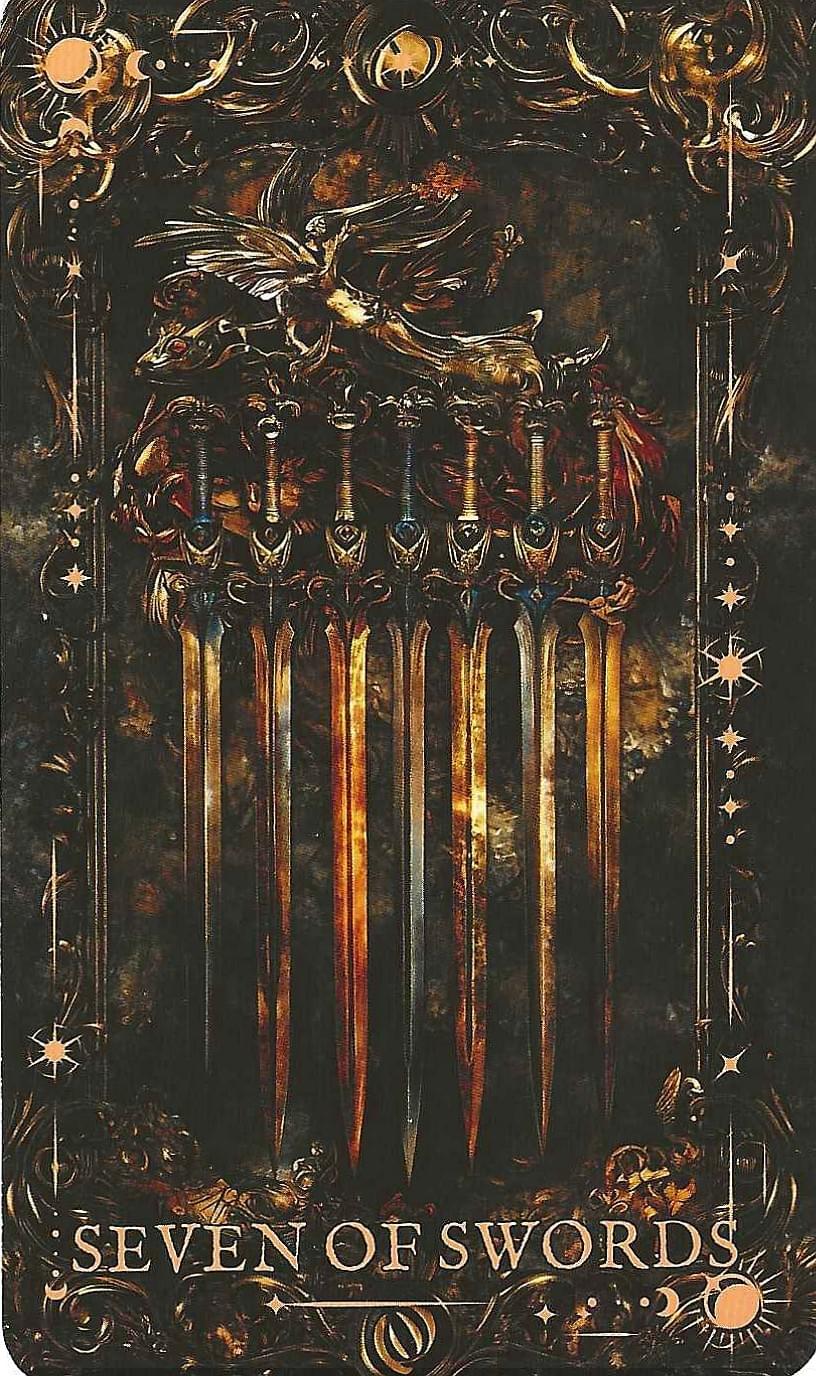
The Arcane Tarot: The Raptor, greed, and the theft-spell
The Arcane comparison is strong, albeit abstract: in the Arcane Tarot, the mind is compromised by greed—trying to steal all Seven swords, looking back hoping to leave none behind. That is the same lesson in a different image:
the mind tries to seize outcomes
but loses coherence in the act
and then looks back—consternation, guilt, paranoia
This is the 7 of Swords pattern: theft, concealment, fragmentation, and looking over the shoulder—whether the thief is “someone else” or the false ego stealing your identity.
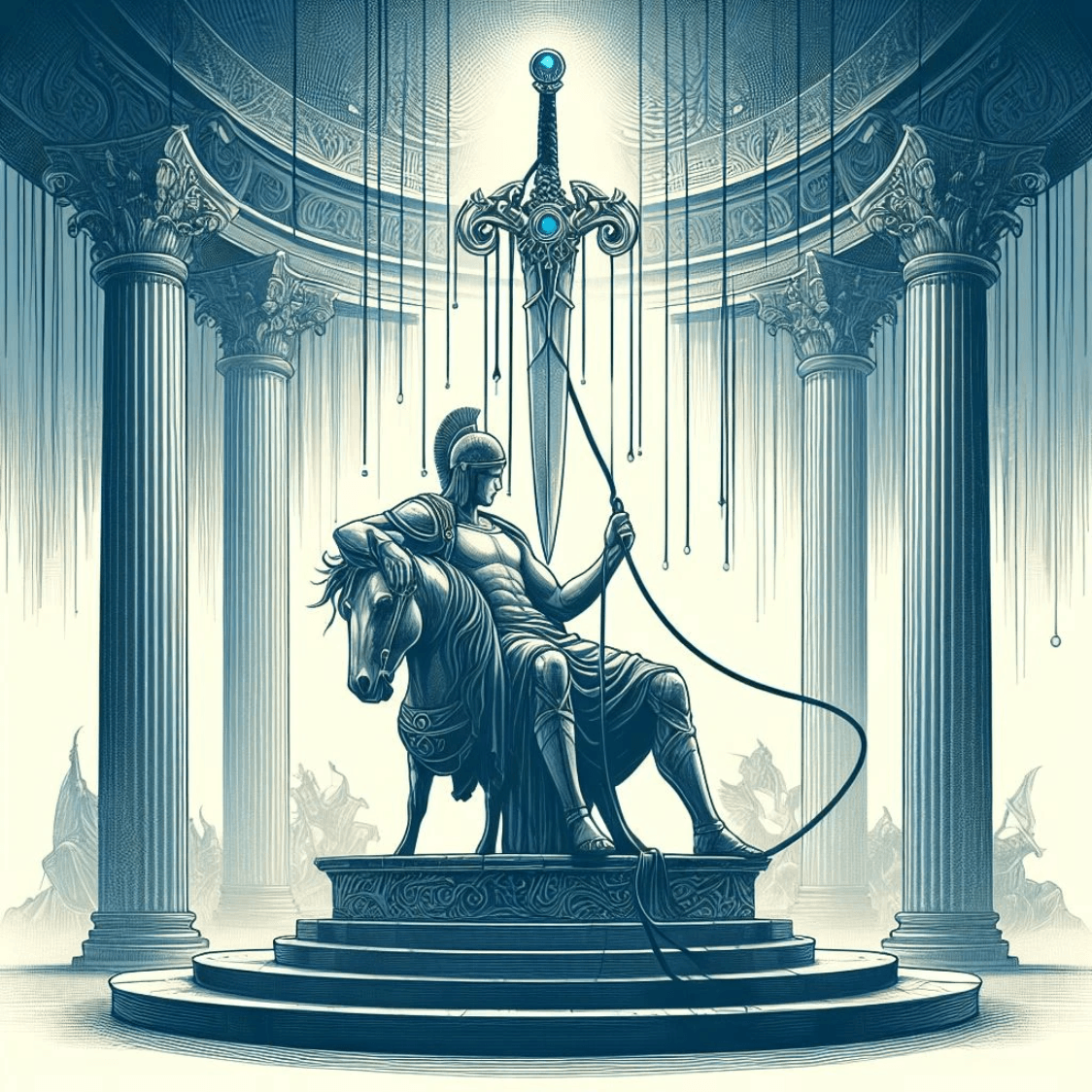
The Sword of Damocles: when the mind rules from fear
Here the myth of Damocles layer works beautifully: the sword hanging by a hair is the constant anxiety that comes with false authority—inner or outer. But the deeper Hermetic correction is:
You are the only authority in your mind.
Thoughts, when charged with emotion, become motion. Your life becomes the momentum of what you repeatedly energize.
So the card’s counsel is not “think harder.” It is think cleaner—and then act.
Closing Hermetic Seal
The Thoth 7 of Swords teaches that unstable effort is not cured by more effort. It is cured by restoring the rightful king to the throne: the Solar Self, the “I AM,” the interior Sun.
When the inner monologue becomes a mind-virus, the magician does one thing:
returns to sovereignty.
Above all things, know thyself.
And remember: you are the thinker, not the thought.
(Click on Magiceli.com deeper insight and ritual of 777.)
The symbols for Netzach, that are used in Western Magic and Tarot are:
- The Medieval Girdle.

2. The Rose.

#. The oil lamp.

.
Arcane Tarot — Seven of Swords
The Arcane Tarot Seven of Swords presents an abstract raptor soaring above seven swords. Though the bird appears to grasp all of them, the weight of these heavy mental burdens makes true flight impossible. The image conveys the futility of trying to carry too many schemes, secrets, or hidden motives at once.
The swords show slight discoloration, resembling copper marked by verdigris, suggesting corruption, decay, or the slow erosion of integrity. The overall dark and gloomy atmosphere reflects a mind in turmoil—clouded by deception, trickery, and shadowed strategy.
Here the intellect becomes burdened by its own cleverness. Strategy turns into strain, secrecy becomes heaviness, and the mind cannot rise while weighed down by concealed intentions.
Divinatory Meaning
Upright
Deception, trickery, or strategic concealment
Attempting to get away with something through dishonesty or evasion
Hidden motives or secret plans
Mental burden from carrying too much secrecy
Acting alone or withholding truth
Advice: Proceed carefully—clever tactics may bring temporary advantage, but consequences follow exposure.
Relationships
Dishonesty or secrecy within a relationship
Avoidance of direct communication
White lies or hidden truths creating distance
Need for transparency before trust erodes
Someone has not been fully honest—possibly the querent. Address the issue before it grows into deeper conflict.
Career / Material Matters
Workplace gossip, hidden agendas, or subtle sabotage
Need to protect one’s position or reputation
Warning against scams, manipulation, or “get-rich-quick” schemes
Strategic action required, but remain ethical and professional
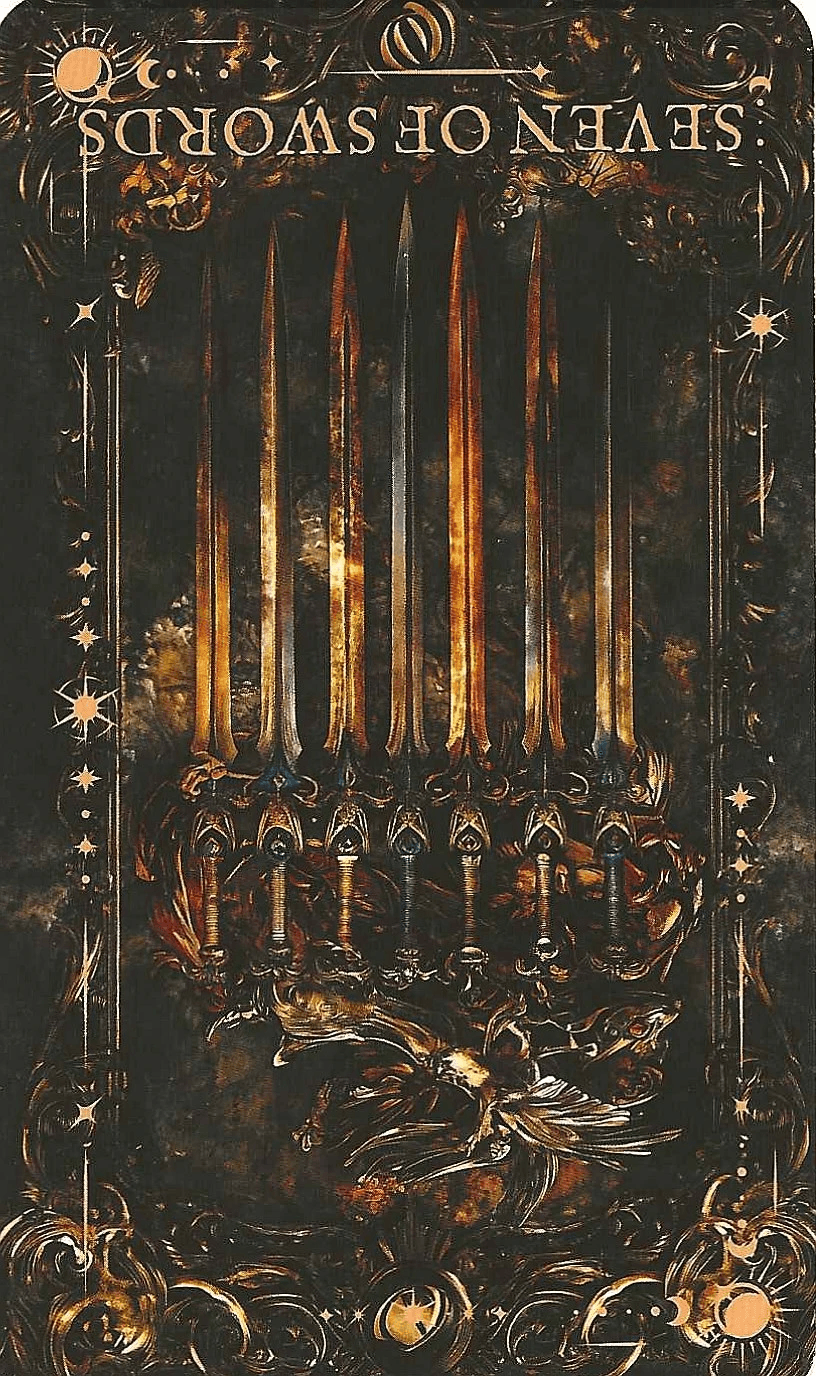
Reversed / Ill-Dignified
Deception exposed; truth coming to light
Lies unraveling or consequences surfacing
Evasiveness no longer sustainable
Confession, accountability, or forced honesty
Release from mental strain once truth is faced
Shadow strategies fail, and clarity replaces concealment.
Thoth Tarot vs Arcane Tarot — Comparative Synthesis
The Thoth Tarot Seven of Swords (Futility) reveals the mechanics of self-sabotage, showing the mind divided against itself as six conflicting forces undermine the central Solar will. It teaches that unstable effort, overthinking, and negative inner dialogue weaken the soul’s directive, reflecting the Hermetic struggle between the Higher Self and the fragmented personality.
In contrast, the Arcane Tarot Seven of Swords portrays the psychological weight of deception itself—an intellect burdened by hidden motives, corruption of thought, and the heaviness of mental turmoil that makes progress impossible. Together, the Thoth exposes the inner process of mental fragmentation and self-defeat, while the Arcane reveals the emotional and ethical consequences of carrying deception, showing that divided intention leads inevitably to futility.
When the 7 of Swords is Thrown During a Reading
The Seven of Swords indicates a state of mental futility, where the querent may feel trapped between desire and self-doubt. It reflects a condition of wanting something deeply while simultaneously believing it cannot be attained—often leading to resignation or abandoning efforts before they even begin.
The mind becomes crowded with conflicting thoughts, where many weak voices of fear and vacillation drown out the one strong will to act. Instead of affirming the power of “I AM,” the querent may fall into the self-denial of “I am not,” repeating limiting mental loops formed from past experiences. These patterns generate avoidance behaviors rooted in the subconscious fear of discomfort or failure.
This card reveals that guilt, resentment, or negative self-talk may be causing the querent to create their own obstacles. Crafty schemes, evasive actions, or manipulations of the ego may appear as solutions, yet ultimately resolve nothing. However, there is opportunity here—by abandoning deceptive strategies, seeking clarity, and accepting wise counsel, one may regroup and regain direction.
The Seven of Swords also suggests a period of transformation. Within 7 weeks or 7 months, the querent may have the opportunity to break through this cloud of self-imposed limitation and move toward authentic creation and self-expression.
Spiritual and Psychological Advice
Declare clearly what you truly desire—this is truth.
Hopelessness and helplessness are false constructs of the divided mind.
Release repetitive “mind loops” that anchor you to past limitations.
Replace self-denial with conscious affirmation of will.
Seek focused action rather than scattered thought.
The energy of the Sevens relates to motion and change—like the Charioteer, the originator of forward movement. This card does not condemn weakness but reminds the querent of their inherent power to choose direction and transform their life through conscious will.
The Seven of Swords may also indicate the release of sabotaging thought patterns formed long ago—possibly rooted in early conditioning or beliefs developed around childhood (often symbolically linked to cycles of seven).
By focusing heart, passion, and creative intention on what is genuinely desired, the noise of programmed self-defeat fades into the background. What once seemed like obstruction becomes merely passing interference on the vast ocean of possibility.
Ill-Dignified / Reversed or Poorly Supported by Surrounding Cards
Deceitfulness or hidden agendas
Intrigue and manipulation
Insincerity or lack of integrity
Betrayal by oneself or others
Self-defeating behavior through avoidance or denial
Here deception—whether internal or external—dominates the situation and must be confronted directly.
Thank you for your interest, your thoughtful comments, subscriptions (free), and your generous support.
Your donations help keep this work alive and accessible to all sincere seekers.
May your generosity return to you in abundance. May you live long and prosper.
3 Western Hermetic Tarot and Magick Websites helping people become more magic and less tragic since 2010.
Nontraditional Tarot Card blogs, home page, Tarot Store, Master Tarot Classes.
Traditional Tarot Card Comparisons Blog and tarot layout store.
Western Hermetic Magick ritual and invocation website and blog.
